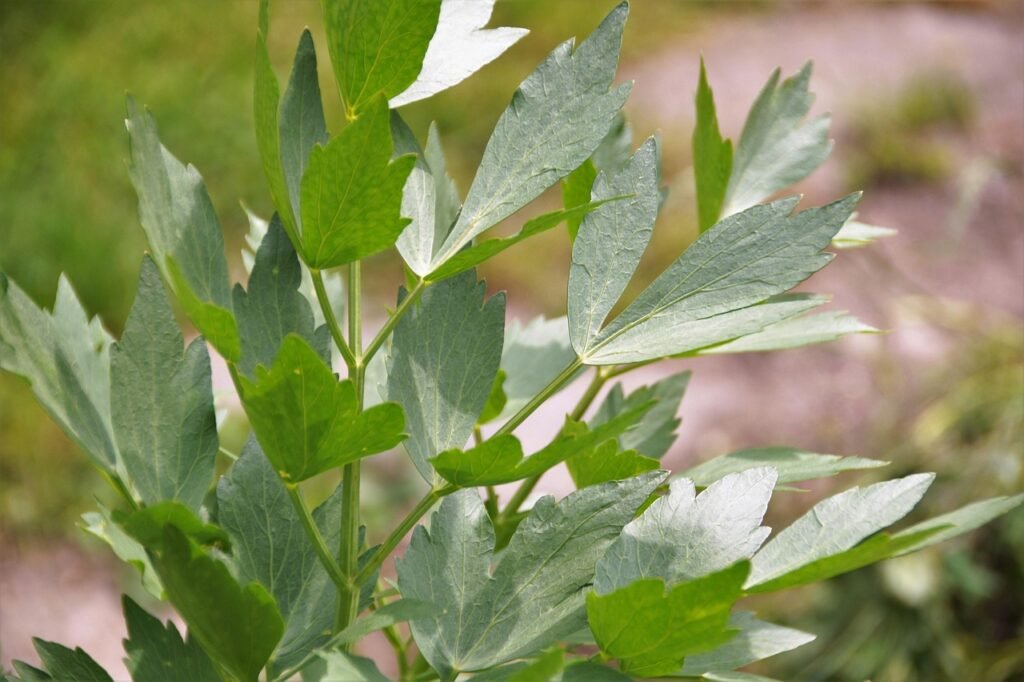
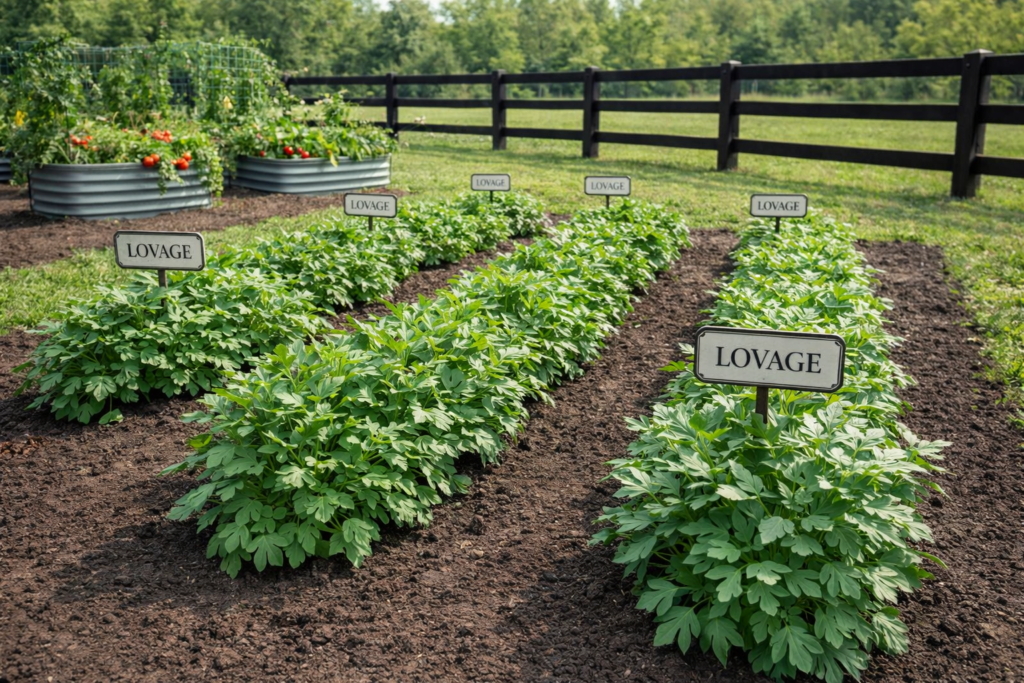
Levisticum officinale
- Latin name: Levisticum officinale
- Family: Apiaceae (carrot / celery family)
- Flavor: Like celery and parsley had a spicy, intense baby.
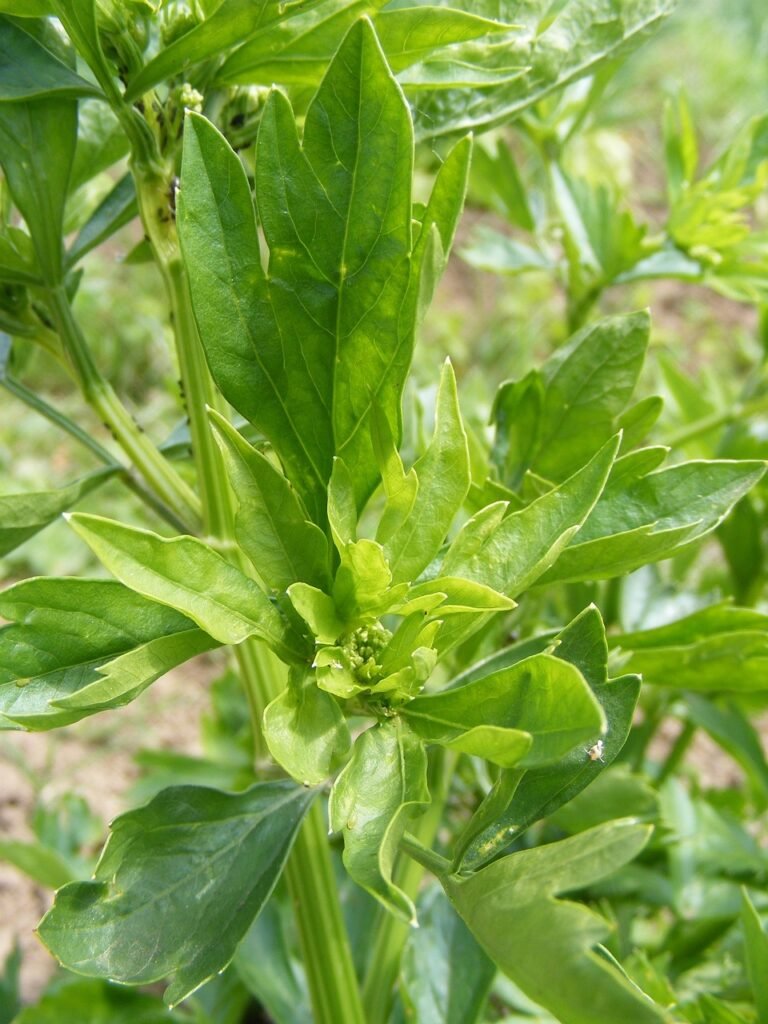
Lovage is a tall, perennial herb (up to ~2.5 m / 8 ft) with hollow stems, glossy divided leaves, and yellow-green umbels of flowers. It’s native to the region of modern-day Afghanistan and Iran, but has been grown for centuries across Europe, parts of Asia, and later North & South America.
In many places, every part of the plant is used:
- Leaves: herb and salad green
- Roots: vegetable & medicine
- Seeds (fruits): spice like fennel or caraway
Key Constituents (and what herbalists traditionally say about them)
(This is educational only — not medical advice or a promise of effects. Anyone with health issues should check with a qualified practitioner before using lovage regularly.)
Lovage’s chemistry has been studied quite a bit. Major groups include:
- Volatile oils (essential oil)
- Rich in phthalides such as ligustilide, butylidenephthalide, sedanolide, etc.
- Traditionally associated with:
- Digestive support: carminative, used for gas and cramping.
- Circulatory & smooth-muscle effects: many phthalides are studied in related plants (like Angelica and Ligusticum) for spasm-easing, vasodilating activity.
- Furanocoumarins
- Examples: bergapten, xanthotoxin and related compounds.
- These can make skin more sensitive to sunlight (photosensitizing) — which is why handling large amounts of fresh root or taking strong preparations is traditionally limited and sun exposure is watched.
- Coumarins (non-furan) & phenolic acids
- Contribute to aroma, mild blood-flow modulation, and antioxidant activity (in test-tube studies).
- Flavonoids
- Quercetin, kaempferol and friends — common plant antioxidants that herbalists link with general tissue protection.
- Minerals & vitamins
- Lovage leaves are noted as a good potassium and vitamin C source in food use, with small amounts of other trace minerals (similar to parsley/celery greens).
Herbal traditions describe lovage root as a mild diuretic/aquaretic, used to encourage urine flow and “flush” the urinary tract, and the aerial parts as digestive, warming, and expectorant (helping move mucus).
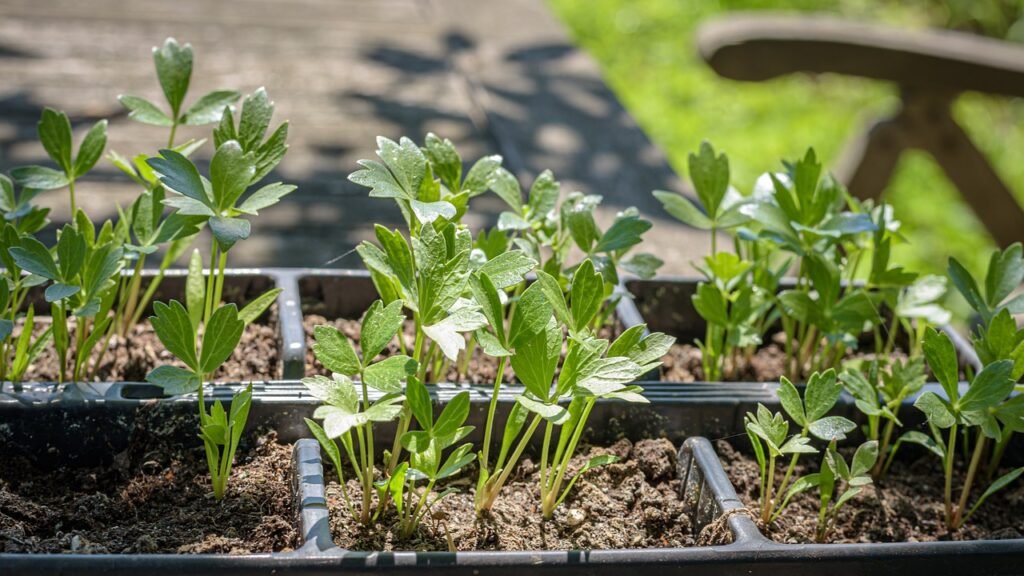
Where Lovage Grows & Who Uses It
- Origin: Southwest Asia (Afghanistan/Iran area).
- Now naturalized / cultivated in: much of Europe, especially Central and Eastern Europe; parts of Western Asia, and garden patches in North America and South America.
Cultural snapshots
- Romania (Leuștean):
Lovage is iconic in Romanian kitchens. Fresh leaves are tossed into sour soups (ciorbă), bean stews, and potato dishes at the very end of cooking for a green, sharp, celery-like perfume. The leaves and seeds are also used in pickles — especially cabbage and cucumbers — to both flavor and help preserve. - The Netherlands:
Lovage is traditionally cooked with white asparagus, served with boiled eggs — a classic spring dish. - Ukraine:
Known as liubystok, historically considered an aphrodisiac herb. Women rinsed their hair with lovage infusions so the scent would “call in love,” and modern hair products there sometimes still include lovage extract. Leaves and roots are used in salads and as seasoning. - UK / Cornwall:
Lovage cordial added to brandy is a traditional winter drink, once used to disguise the salty taste of smuggled brandy.
Traditional Health Uses (bird’s-eye view)
Again, for education only:
- Digestive:
Used as a warming, carminative herb — added to heavy dishes, bean soups, and meat stews to help with gas, sluggish digestion, and that “stuck” feeling after eating. - Urinary & fluid balance:
The root especially has been used in European herbalism as a mild diuretic/aquaretic to support urinary tract health and fluid elimination. - Respiratory:
In folk practice, an aromatic tea (often blended with thyme or fennel) is sipped warm for chest congestion and stubborn mucus. - Women’s health:
Historically referenced as an emmenagogue (to bring on delayed menses), which is one reason it’s often avoided in pregnancy at medicinal doses.
Working with Lovage in the Kitchen
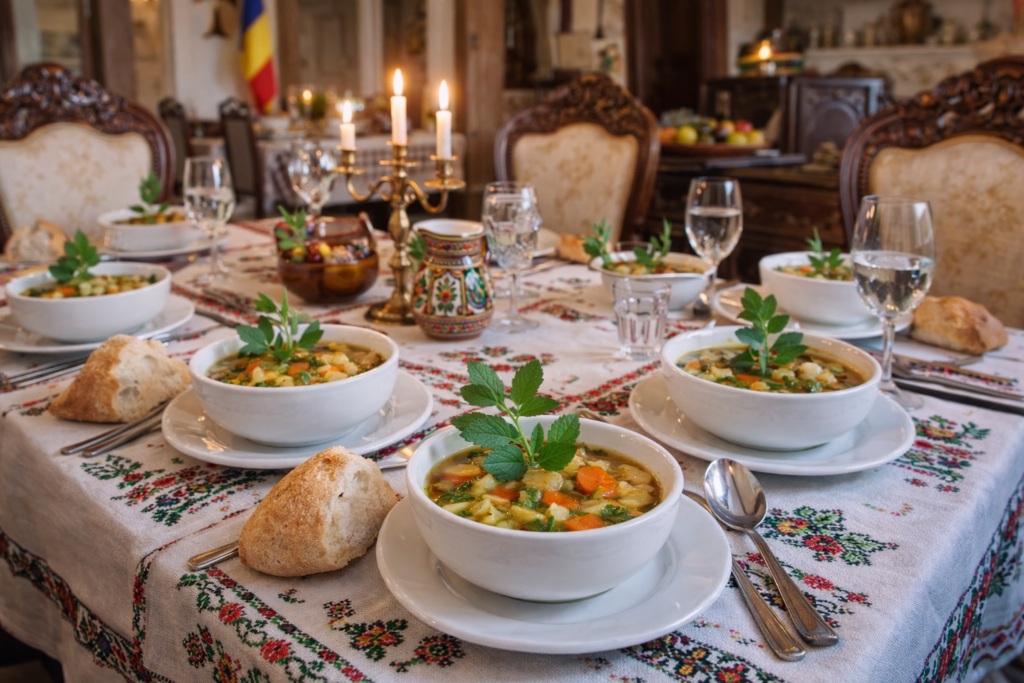
1. Rustic Romanian-Style Lovage Soup (Ciorbă cu Leuștean)
A simplified, story-friendly version you can tweak — not a strict traditional recipe.
Serves: 4
Ingredients
- 2 Tbsp butter or olive oil
- 1 medium onion, finely chopped
- 2 carrots, diced
- 1 parsnip or parsley root, diced
- 2 potatoes, peeled & cubed
- 1 small piece of celery root (optional), diced
- 6 cups (1.4 L) good broth (chicken or vegetable)
- 1–2 Tbsp vinegar or juice from sauerkraut/pickles (for that “sour ciorbă” note)
- 1 cup chopped fresh tomatoes or 2 Tbsp tomato paste
- ½ tsp salt to start (adjust later), black pepper to taste
- ½–1 cup fresh lovage leaves, finely chopped (start smaller — it’s strong!)
- Optional: a spoon of sour cream or yogurt in each bowl
Method
- Gently sauté onion in butter/oil until translucent.
- Add carrots, parsnip, potatoes, celery root; cook 3–4 minutes, stirring.
- Pour in broth, add tomatoes/tomato paste, a little salt and pepper. Simmer until vegetables are tender (20–25 minutes).
- Taste and brighten with vinegar or kraut juice — just enough to give a pleasant tang.
- Remove from heat and stir in the chopped lovage right at the end so its aroma stays vivid.
- Serve with a dollop of sour cream/yogurt and extra lovage sprinkled on top if you like.
Herbal Preparations with Lovage
General notes & safety
- Use culinary amounts freely if you tolerate celery/parsley.
- For medicinal-strength teas, tinctures, etc., traditional herbalists:
- Avoid in pregnancy and often in breast-feeding (uterine & hormonal history, plus limited modern research).
- Use cautiously in those with kidney issues or on prescription diuretics.
- Caution sun exposure with strong root preparations (furanocoumarins → photosensitivity).
- Avoid if allergic to celery, carrot, or other Apiaceae.
Always encourage your readers to run things past their own practitioner if they have medical conditions or take medication.
2. Lovage Leaf Tea (Digestive & Culinary)
Simple kitchen tea
- 1–2 tsp dried lovage leaf (or 1–2 Tbsp fresh, chopped)
- 8 oz (240 ml) just-off-boil water
- Place leaves in a covered mug or teapot.
- Pour hot water over, cover, and steep 10–15 minutes.
- Strain.
- Drink 1 cup after meals as a fragrant, celery-like digestif — or use the tea as part of a broth or soup base.
Flavor pairings (synergy in the cup):
- With fennel seed & peppermint for gassy, heavy meals.
- With lemon balm & chamomile when digestion is tangled with tension.
3. Lovage Root Decoction (Traditional Urinary/“Clearing” Tea)
(For educational purposes – strong, so this is where you’d stress checking with a professional.)
- 1 Tbsp dried chopped lovage root
- 10–12 oz (300–350 ml) water
- Add root to a small pot with water.
- Bring to a gentle simmer, cover, and decoct 15–20 minutes.
- Strain; sip in divided doses across the day.
Often combined with dandelion leaf or nettle in traditional blends to support fluid movement and mineral balance (herbal synergy for “spring tonics”).
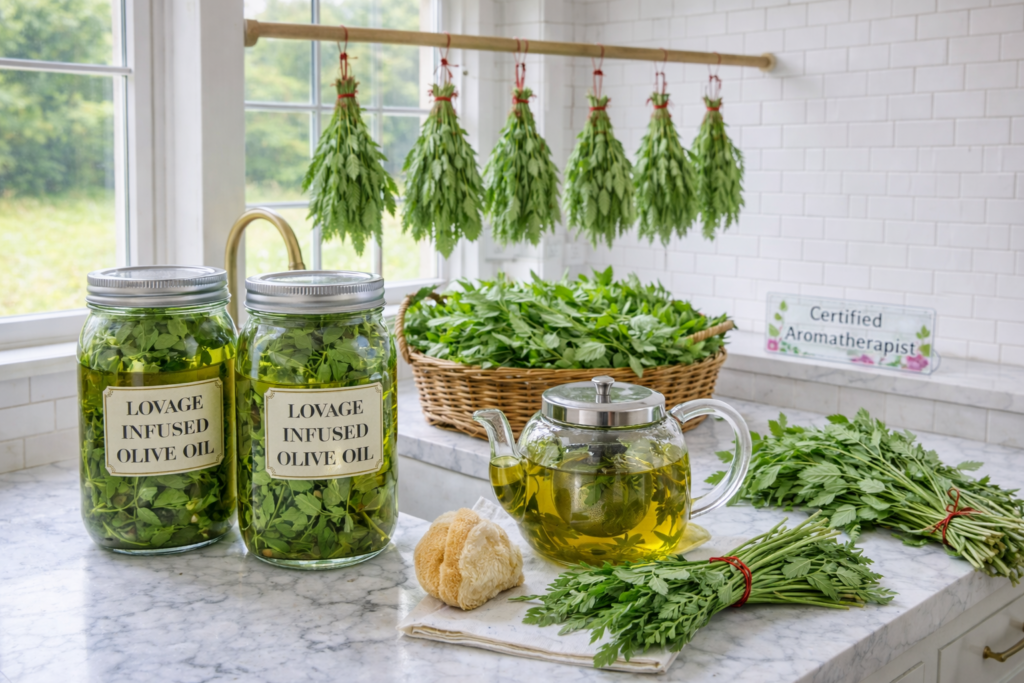
4. Lovage-Infused Oil
Lovely as a massage or chest-rub base when blended with other herbs or essential oils.
You’ll need
- Clean, dry lovage leaves (or a mix of leaf & seed)
- A mild carrier oil (olive, sunflower, sweet almond)
- Glass jar with lid
Method (cold infusion)
- Make sure the plant material is completely dry (moisture invites mold).
- Loosely fill a jar ~½–¾ full with crumbled leaves.
- Cover with oil, leaving ~1 inch of headspace; stir with a clean spoon to release air bubbles.
- Cap and place in a cool, dark spot for 4–6 weeks, shaking a few times a week.
- Strain through a fine cloth; label and date.
This infused oil can become the base for salves, massage oils, or “kitchen witch” anointing oils, especially when blended with thyme, rosemary, or angelica for a warming aromatic rub.
5. Lovage Salve (for Stiff Joints / Chest Rub – traditional style)
Basic formula
- 1 cup (240 ml) lovage infused oil
- 1 oz (28 g) beeswax pellets
- Optional: a few drops of essential oils like rosemary or thyme (if well tolerated)
- Gently warm infused oil in a double boiler.
- Add beeswax and stir until fully melted.
- Test hardness by dropping a bit on a cold spoon; add more wax for a firmer salve, more oil for a softer one.
- Remove from heat, add optional essential oils, stir and pour into tins or jars.
- Label & date.
Traditionally rubbed on cold hands & feet, over tight muscles, or used as a fragrant chest rub (keeping away from direct sun on freshly-salved skin because of those furanocoumarins).
6. Lovage Tincture (Folk Method)
For educational reference — this is how a home herbalist might prepare it. Anyone replicating should research alcohol use, dosing, and safety on their own.
Materials
- Fresh lovage root (or a root + seed mix), finely chopped
- 80-100 proof alcohol (vodka, brandy)
- Glass jar with lid
Ratio (approximate folk method)
- Fill a jar ½–¾ full with chopped root.
- Cover with alcohol so it’s about 1–2 inches above the plant material.
- Cap, label, and keep in a dark cupboard 4–6 weeks, shaking every few days.
- Strain and bottle in amber glass.
A more precise ratio used by some herbalists is 1:5, 40% alcohol (1 part dried root by weight to 5 parts alcohol by volume).
Traditionally, very small amounts (think drops to ½ tsp, diluted in water) are used for digestive or urinary formulas, often together with fennel, angelica, or dandelion for synergistic blends.
Synergy with Other Herbs
Lovage plays well with others:
- For digestion
- Lovage + fennel seed + peppermint → classic post-meal blend.
- Lovage + ginger + lemon → warming, circulatory, “winter soup” flavor.
- For urinary support (traditional)
- Lovage root + dandelion leaf + nettle leaf
A springtime “drainage” trio in European folk practice.
- Lovage root + dandelion leaf + nettle leaf
- For respiratory blends
- Lovage leaf + thyme + hyssop
Aromatic, used in steamy broths or warm teas for heavy, stuck mucus.
- Lovage leaf + thyme + hyssop
You can frame all of these as historic herbal patterns, then gently encourage readers to explore modern resources, monographs, and safety info if they’re drawn deeper.
A gentle “research this more” nudge
If you want to spark curiosity without over-promising, you might add a short sidebar in your article like:
“In traditional European herbalism, lovage root was regarded as a cleansing, moving herb for the kidneys and urinary tract, while the strongly aromatic leaves went into everyday soups and stews to help the body handle rich foods. Modern herbal texts still discuss these uses, but if you’re dealing with medical conditions or taking prescriptions, always check with a qualified practitioner before using lovage regularly — especially in tincture or strong tea form.”
If you enjoy stories like this, you’ll love the other life lessons & memories I’m sharing on The Appalachian Sage. …………And if you’re ever in the mood to browse something pretty, you can stop by my Etsy shop, The Appalachian Sage Shop, where I pour the same love and kindness into each design.