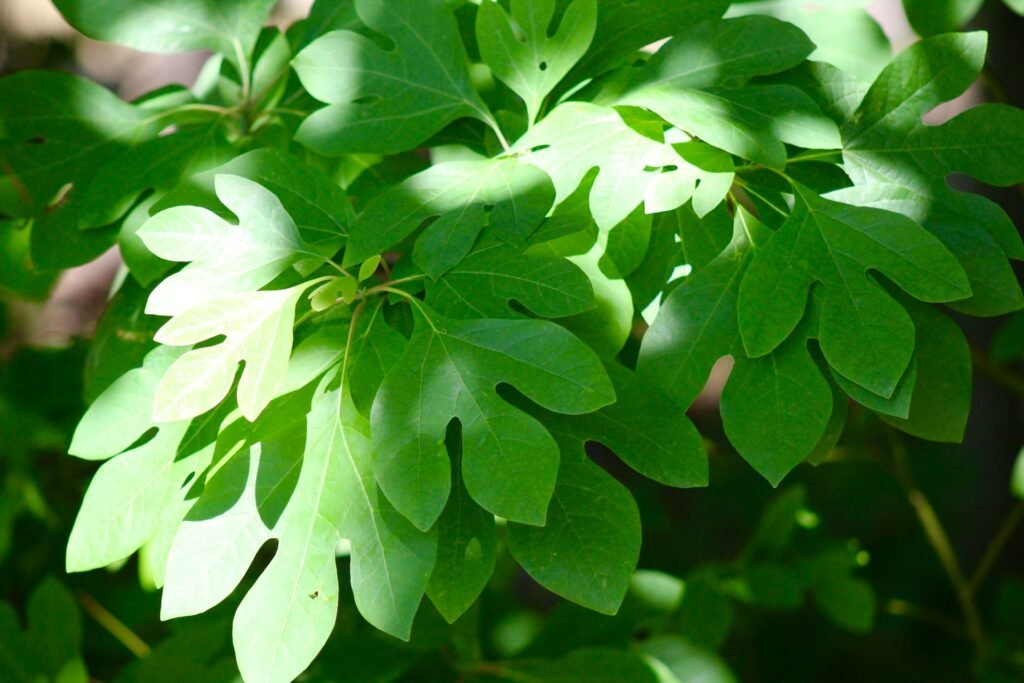
Sassafras is not a weed.
It is a tree — a native North American woodland elder that has been respected for centuries for its fragrance, medicine, and spirit.
Sassafras (Sassafras albidum) is a deciduous tree that can reach 30–60 feet tall, with a sturdy trunk, spreading branches, and a deep, aromatic root system. It grows slowly and lives for decades, sometimes longer, quietly shaping the forests it inhabits.
In Indigenous traditions, trees were never treated casually. They were regarded as elders — teachers with memory, power, and responsibility. Sassafras was one of those trees.
A Tree Easily Recognized
Sassafras is one of the easiest trees to identify once you know it. It has been used medicinally in many cultures….but one thing is for sure: IT IS NOT A CASUAL PLANT!!! THERE IS A WORD OF WARNING….SASSAFRAS MUST BE RECOGNIZED AS A VERY SERIOUS CAUTIONARY PLANT SUBSTANCE. KNOW THE DETAILS!!!
Unique Leaf Patterns
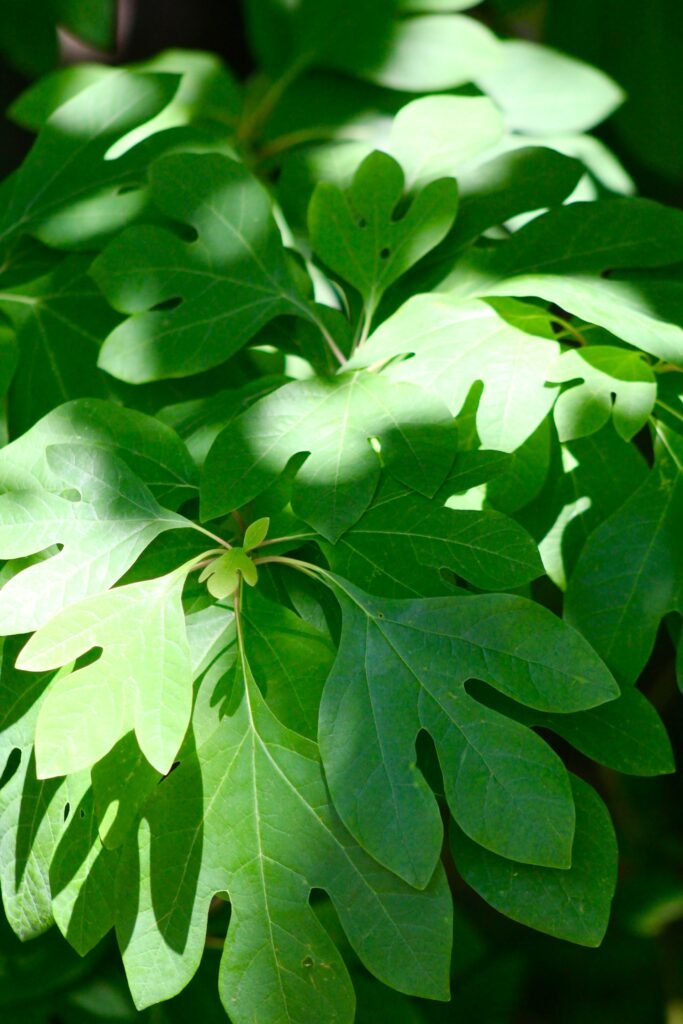
One of its most remarkable features is that a single sassafras tree carries three different leaf shapes at once:
- single-lobed leaves
- two-lobed “mitten-shaped” leaves
- three-lobed leaves
This unusual characteristic makes sassafras stand out in the woods and has fascinated botanists and foragers alike for generations.
A Scent You Never Forget
The roots, bark, and twigs release a warm, sweet, spicy aroma when cut or bruised — often described as root beer–like, earthy, and comforting. This scent comes from the tree’s volatile oils and is one reason sassafras became so deeply loved across the American South.
Where Sassafras Grows
Native Range
Sassafras is native to eastern North America, growing from:
- southeastern Canada
- throughout the eastern and southeastern United States
- down into the Gulf Coast states
- westward into parts of Texas and Oklahoma
It thrives in:
- open woodlands
- forest edges
- old fields
- riverbanks
- mixed hardwood forests
Sassafras often spreads by root suckers, producing young saplings near the parent tree, which is why uninformed observers sometimes mistake young growth for “weeds.” Botanically and culturally, this is incorrect. These are simply young trees. I often remember the playground at school, Parksville Elementary, in Parksville, KY…. It no longer exists, but when I was in the 1st-3rd grades of school, I attended that little school in the heart of Kentucky. We had a side playground, and I didn’t play on the actual playground, instead I was one who headed to the hillside of the playground. There I found a Sassafras tree, and its roots were on top of the ground…. I can remember taking a rock and beating that root all the time just to get a splinter or two of Sassafras wood and chew on it….I did that as a kid…LOL….. I LOVE the scent and taste of Sassafras!!! I don’t recommend anyone doing this today, but back then, we didn’t know about the danger of the component in Sassafras…. We all drank Sassafras tea in the South back then…and loved it…
Sassafras in Cherokee Medicine
Cherokee medicine men worked with sassafras as a medicine tree, not a casual herb.
Its use was seasonal, intentional, and respectful, often accompanied by prayer and ceremony. Sassafras was not consumed daily or indiscriminately.
Traditional Cherokee Uses
- Spring cleansing tonic: Sassafras root or bark tea was used to help the body transition out of winter stagnation and restore balance.
- Digestive support: Small amounts were used to stimulate digestion and relieve discomfort.
- Fever and illness support: Included in broader herbal formulas to encourage sweating and recovery.
- Spiritual cleansing: Sassafras carried energetic associations with renewal and purification.
Cherokee healers understood that sassafras was powerful. It was never treated as harmless or weak medicine. Knowledge of preparation, timing, and dosage mattered.
Chemical Components of Sassafras (and Why They Matter)
The very qualities that made sassafras beloved also demand caution.
Key Compounds
SASSAFROL
- The main aromatic compound in sassafras root and bark
- Responsible for the classic root beer scent
- Historically used in foods and beverages
- (Closely related, often confused with safrole)
- Sassafrol is a naturally occurring aromatic compound closely related to safrole. It contributes to the characteristic fragrance and flavor traditionally associated with sassafras.
- Scientific studies show sassafrol: interacts with metabolic enzymes, influences detoxification pathways, exhibits antimicrobial and antifungal activity in vitro (lab settings)
- “In vitro” means: effects seen in test tubes or cell cultures, not the same as proven effects in human bodies
- Still, these findings help explain: why sassafras was used for cleansing, why it was used for infections and digestion, Traditional context
- Cherokee practitioners understood sassafras as: warming, moving, cleansing
- not meant for prolonged use
- Science supports that it stimulates biological activity, which aligns with those descriptions.
SAFROLE
- Closely related to sassafrol
- Present in highest concentration in root bark and essential oil
- Identified in animal studies as carcinogenic at high doses
- (The most discussed and controversial compound)
- Safrole is a naturally occurring aromatic compound found primarily in sassafras root bark and essential oil. It is responsible for much of the tree’s distinctive scent.
- Peer-reviewed laboratory and animal studies have shown that:
- Safrole is biologically active
- It affects liver enzyme pathways
- In high, isolated doses, it can form metabolites that damage DNA in animal models
- This is why safrole became a focus of toxicology research in the mid-20th century.
- Safrole is not inert
- The concern is dose, concentration, and frequency
- These studies involved isolated compounds, not small, seasonal whole-plant teas
- Cherokee medicine men: used it seasonally, often in spring, did not use sassafras daily, avoided concentrated oils, treated it as strong medicine
- Modern science supports the idea that concentration matters.
- Health warnings
- Safrole is classified as potentially carcinogenic at high doses
- Avoid sassafras essential oil
- Avoid concentrated root bark extracts
- Avoid use during pregnancy or breastfeeding
Other Volatile Oils
- Terpenes
- Phenolic compounds
- Camphor-like constituents
These contribute to sassafras’s scent, warming quality, and traditional medicinal effects.
Health Warnings and Modern Understanding
Because of safrole:
- The FDA banned safrole-containing sassafras oil from commercial food use decades ago
- Traditional use was small, seasonal, and limited, not constant ingestion
- Concentrated essential oils are not safe for casual use
Who Should Avoid Sassafras
- Pregnant or nursing individuals
- Anyone using concentrated root bark or essential oil
- Anyone consuming large or continuous doses
Traditional use does not equal modern overuse. Cherokee medicine honored restraint.
How People Can Safely Buy Sassafras Today
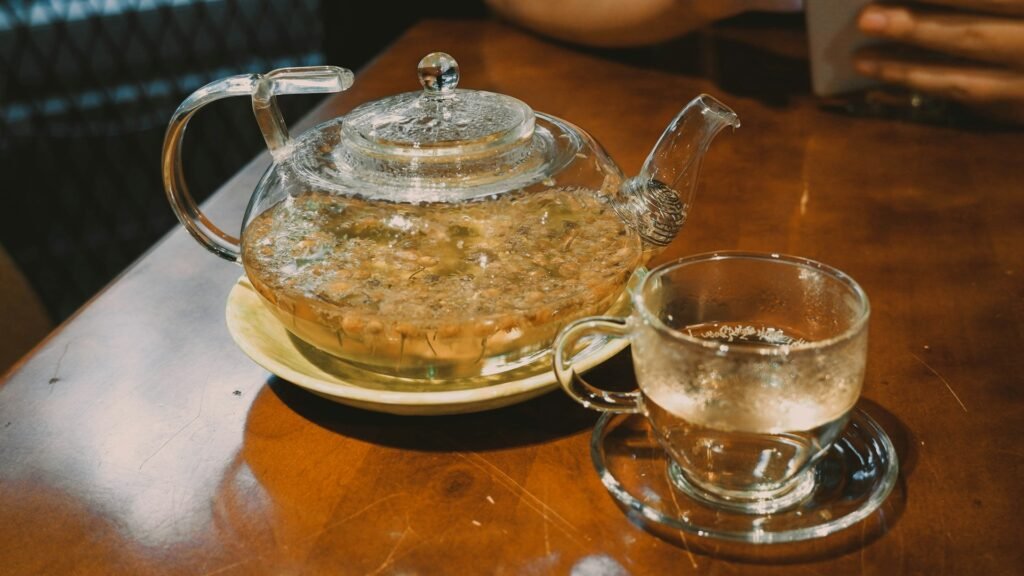
Sassafras can still be enjoyed safely and responsibly today if purchased correctly.
Safe Options
- Safrole-free sassafras extracts (used in food flavoring)
- Commercial root beer flavorings made without safrole
- Herbal teas clearly labeled as safrole-free
- Dried leaves (much lower in safrole than roots)
- Try Option for Sassagras Tea Concentrate (Safe version) on Amazon…Research Pappy’s, Nelsons, etc…. Also, Claey’s hard candy in Sassafras flavor…. I love each of them.
What to Avoid
- Raw root bark sold without processing
- Sassafras essential oil
- Homemade concentrated extracts
Always purchase from reputable herbal suppliers who understand modern safety standards.
Sassafras Beyond North America
While Sassafras albidum is native to North America, related sassafras species and aromatic trees exist in:
- East Asia (China, Taiwan)
- Parts of Europe (as ornamentals)
- Botanical gardens worldwide
Different cultures have used aromatic trees similarly — for scent, digestion, ceremonial cleansing, and medicine — though the species and chemistry differ.
Vitamins in Sassafras Tea (Naturally Occurring, Small Amounts)
When sassafras was traditionally brewed as a light, short-term tea (not concentrated), it could contain trace amounts of the following:
🌿 Vitamin C
- Present in small amounts, especially when made from fresh material
- Likely contributed to its historical use as a spring tonic
- Not high enough to be considered a reliable vitamin C source
🌿 Vitamin A precursors (trace carotenoids)
- Found primarily in leaves, not roots
- Very minor amounts
- Not nutritionally significant compared to leafy greens
🌿 B-vitamin traces
- Extremely small, inconsistent amounts
- Not a meaningful source of B vitamins
What Sassafras Tea Is NOT
It is not a significant source of:
- Vitamin D
- Vitamin E
- Vitamin K
- Iron, calcium, or magnesium (in meaningful amounts)
So if anyone ever claimed sassafras tea was taken “for vitamins,” that’s a modern misunderstanding.
What Sassafras Tea Was Actually Valued For
Historically (Cherokee and Southern folk use), sassafras tea was appreciated for:
- 🌱 Aromatic stimulation (wakes up digestion)
- 🔥 Warming effect (circulation, sweating)
- 🌿 Seasonal cleansing (spring use, not daily)
- 💨 Gentle diaphoretic action (supports fever breaking)
- 🫖 Comfort and tradition (taste, smell, ritual)
Those effects come from volatile oils and phenolic compounds, not vitamins.
Important Safety Note (worth repeating)
Traditional sassafras tea:
- was used briefly
- was not consumed daily
- was not concentrated
- avoided essential oils
Modern concerns about safrole are why:
- commercial teas today are safrole-free
- roots and oils are restricted
- leaves are sometimes preferred
Bottom line (this is the clean takeaway)
Sassafras tea contains only trace vitamins.
Its historical value lies in plant chemistry and tradition, not nutrition.
If someone wants vitamins → nettle, red clover, dandelion, rose hips.
If someone wanted sassafras → they wanted warmth, scent, movement, and spring renewal.
The South’s Love Affair With Sassafras Tea
For generations, especially in the American South and Appalachia, sassafras tea was a beloved household staple.
It was remembered as:
- a springtime ritual
- a warming drink
- a folk tonic
- a taste of home
Older generations still speak of it with affection — not as a trend, but as tradition.
A Tree to Be Respected
Sassafras is not folklore.
It is not a weed.
It is not harmless.
It is a medicine tree with memory, chemistry, and cultural weight.
Cherokee medicine men understood this deeply. They used sassafras sparingly, seasonally, and with reverence — never as a casual daily beverage, never without understanding.
When approached with respect and knowledge, sassafras remains what it has always been:
- fragrant
- grounding
- symbolic of renewal
- deeply tied to land and memory
And perhaps that is why its scent still stops people in their tracks — reminding them of forests, kitchens, elders, and a time when life moved a little slower.
If you enjoy stories like this, you’ll love the other life lessons & memories I’m sharing on The Appalachian Sage. …………And if you’re ever in the mood to browse something pretty, you can stop by my Etsy shop, The Appalachian Sage Shop, where I pour the same love and kindness into each design.