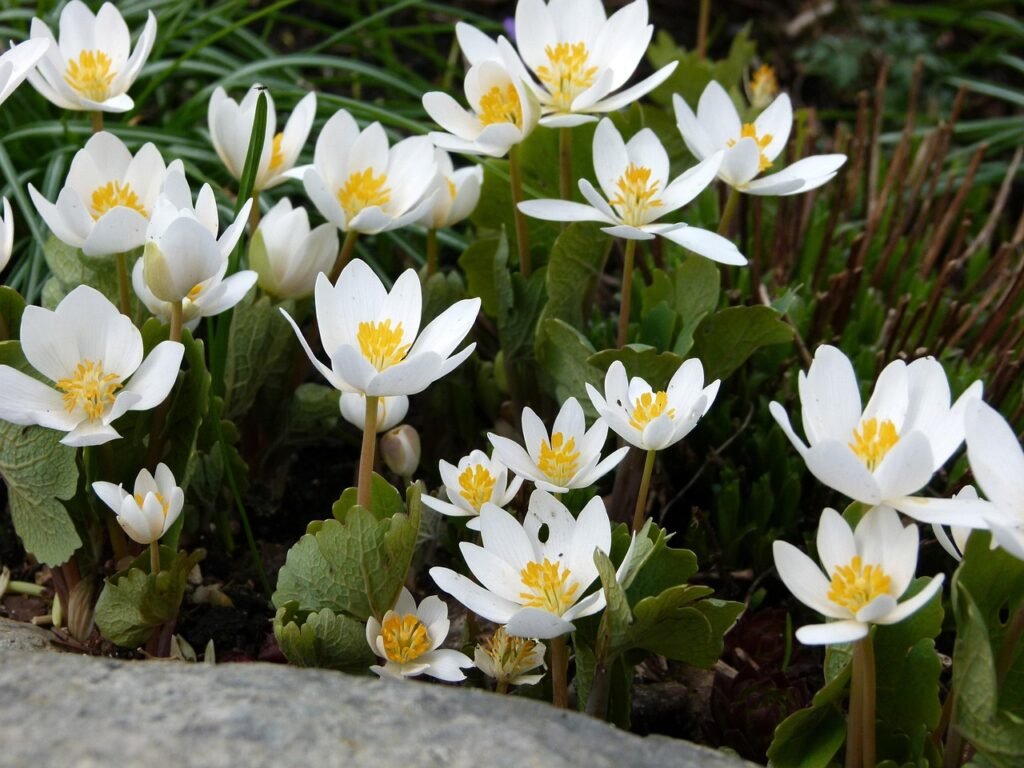
Bloodroot (Sanguinaria canadensis) is one of the most striking and controversial native plants of North America. Known for its bright red sap that resembles fresh blood when the root is cut, this woodland plant has long held a place in Indigenous medicine, early American herbalism, and Appalachian folk practice. It is powerful, symbolic, and not forgiving of misuse.
Bloodroot grows in rich, moist hardwood forests throughout eastern North America, including Appalachia, the Ohio River Valley, and much of Kentucky. It appears early in spring, often before trees fully leaf out, sending up a single white flower wrapped in a curled leaf that later unfurls as the flower fades.
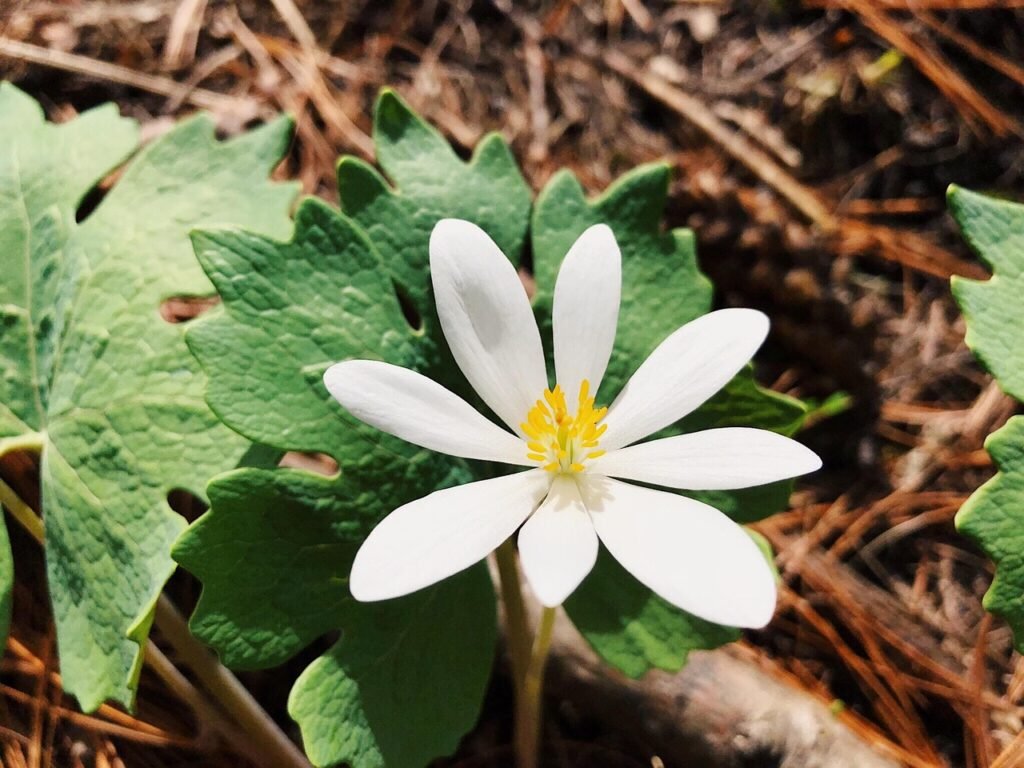
Identifying Bloodroot
- Botanical name: Sanguinaria canadensis
- Family: Papaveraceae (Poppy family)
- Growth habit: Low-growing woodland perennial
- Leaves: Blue-green, deeply lobed, palm-shaped
- Flowers: White, 8–12 petals, yellow center
- Root: Thick rhizome that exudes vivid red-orange sap when cut
The red sap is where the plant gets its name — sanguinaria meaning “of blood.”
How Granny Witches Used Bloodroot Alkaloids (and Why)
Granny witches and mountain healers did not think in terms of chemical names like “sanguinarine” or “chelerythrine.” What they understood was behavior — how a plant acted on the body.
Bloodroot was known as a “hot,” “burning,” or “cutting” plant. It was never considered gentle medicine. It belonged to a small category of plants used only when nothing else worked.
How It Was Used
Historically, granny witches used Bloodroot very narrowly:
- External use only
- In minute amounts
- For stubborn, non-healing conditions
- When infection, rot, or growth would not respond to milder plants
Typical folk uses included:
- Touching warts or fungal lesions
- Treating ringworm or stubborn skin infections
- Symbolic or ritual “cutting away” of illness
- Dyeing, marking, or ceremonial use
It was never a daily remedy. It was never taken lightly.
They knew — from observation — that it:
- Burned tissue
- Killed flesh
- Left scars if misused
That was the point, but also the danger.
Why They Believed It Worked
Granny witches worked from visible results, not theory.
They saw that Bloodroot:
- Destroyed diseased tissue quickly
- Prevented spread of certain infections
- “Stopped rot” when other plants failed
In an era with:
- No antibiotics
- No sterile surgery
- No dermatology
this sometimes meant the difference between losing a limb or surviving.
They believed illness could be:
- “Cut out”
- “Burned off”
- “Driven away”
And Bloodroot did exactly that — indiscriminately.
Why Granny Witches Stopped Using It
This part matters most.
Granny witches were not reckless, and they adapted when knowledge changed.
Over time, they observed patterns:
- Deep scarring
- Slow healing wounds
- Infections after use
- Damage extending far beyond the original problem
As safer plants became available — and later, antibiotics and medical care — the risk no longer outweighed the benefit.
They quietly retired the plant.
This is a key truth many people miss:
Granny witches stopped using Bloodroot before modern medicine told them to.
Why Modern “Black Salve” Is Not Traditional
The modern promotion of Bloodroot-based black salves is not true granny-witch practice.
Traditional use was:
- Local
- Limited
- Observational
- Cautious
- Rare
Modern black salve use is often:
- Broad
- Aggressive
- Commercialized
- Marketed with false cancer claims
- Detached from traditional ethics
That disconnect is where harm happens.
Why Granny Witches Don’t Use It Now
Today’s herbal wisdom says:
- Bloodroot’s alkaloids are too caustic
- They do not distinguish healthy tissue
- The damage is unpredictable
- Safer options exist
Modern granny-witch practice focuses on:
- Supporting the body, not destroying tissue
- Encouraging natural healing processes
- Choosing plants that work with the body, not against it
Bloodroot doesn’t meet that standard anymore.
The Deeper Lesson Mountain Healers/Granny Witches Understood
Granny witches believed:
“A plant is not holy just because it is old.”
Wisdom meant knowing when to stop using something, not clinging to it out of tradition or pride.
Bloodroot taught them:
- Power is not the same as wisdom
- Nature contains both medicine and poison
- Knowledge must evolve
Plain Truth Summary
- Granny witches used Bloodroot rarely and externally
- They understood it was dangerous
- They stopped using it as safer options emerged
- Modern misuse is not traditional
- Ethical herbalism means knowing what to let go
Major Chemical Components
Bloodroot contains benzylisoquinoline alkaloids, which are responsible for both its historical medicinal use and its toxicity.
Key compounds include:
- Sanguinarine – Strongly antimicrobial, caustic, and cytotoxic. Sanguinarine is a benzylisoquinoline alkaloid found primarily in bloodroot (Sanguinaria canadensis) and is the compound responsible for both the plant’s historical medicinal use and its well-documented toxicity. Chemically, sanguinarine is highly bioactive and interacts directly with cellular membranes and proteins, which explains its strong antimicrobial and antifungal properties. It disrupts microbial cell walls and interferes with enzymatic activity, making it effective against bacteria and fungi in laboratory settings. However, this same mechanism also affects human tissue. Sanguinarine is cytotoxic, meaning it can cause programmed cell death and tissue necrosis when applied directly or taken internally. Historically, this destructive action was interpreted as “drawing out disease,” but modern research shows it does not distinguish between healthy and unhealthy cells. Because sanguinarine readily penetrates skin and mucous membranes and accumulates in tissue, uncontrolled exposure can lead to burns, ulceration, scarring, and systemic toxicity. Today, its use is limited to highly regulated, trace-level applications in research and formerly in dental products, with strict controls due to safety concerns. sanguinarine is one of the key compounds historically involved in so-called “black salve”, and your understanding about it destroying healthy tissue along with diseased tissue is correct. Let me explain this cleanly and carefully.
- Black salve (sometimes called escharotic salve) was commonly made from bloodroot (Sanguinaria canadensis), whose active alkaloid is sanguinarine, often combined with zinc chloride. Sanguinarine is caustic and cytotoxic — it kills cells on contact — and zinc chloride intensifies that destructive action. Together, they cause tissue necrosis, forming a black scab (eschar) that eventually sloughs off. Historically, this was interpreted as the salve “drawing out” tumors or disease.
- The critical problem — now well documented — is that sanguinarine does not discriminate. It destroys healthy tissue, blood vessels, nerves, and connective tissue just as readily as abnormal cells. Modern pathology has shown that black salve can:
- Mask underlying cancers rather than cure them
- Cause deep tissue damage, scarring, infection, and permanent disfigurement
- Delay proper diagnosis and treatment
- Chelerythrine – Irritant, affects cellular membranes. Chelerythrine is one of the compounds that reminds us why wisdom must guide tradition. Power without discernment harms as easily as it heals. What Chelerythrine Is
Chelerythrine is a benzophenanthridine alkaloid, a class of plant compounds known for being biologically potent and chemically aggressive. It occurs naturally in bloodroot (Sanguinaria canadensis), as well as in some related plants in the poppy family (Papaveraceae).
This compound is not a vitamin, nutrient, or gentle phytochemical. It is a bioactive alkaloid that plants produce primarily as a defense mechanism against insects, fungi, and grazing animals.
How Chelerythrine Acts in the Body (Mechanism)
Chelerythrine is best known in modern science as a protein kinase C (PKC) inhibitor.
Protein kinase C enzymes are involved in:
Cell signaling
Cell growth and division
Inflammation pathways
Muscle contraction
Apoptosis (programmed cell death)
Chelerythrine disrupts these pathways, which explains both:
Why it has drawn laboratory research interest
Why it is dangerous outside of controlled settings
At the cellular level, chelerythrine:
Interferes with normal cell membrane signaling
Triggers apoptosis and necrosis
Can cause oxidative stress
Disrupts calcium regulation in cells
This disruption is non-selective — healthy cells are affected just as readily as abnormal ones.
Why It Was Historically Used
In traditional North American herbal practices, chelerythrine-containing plants (especially Bloodroot) were sometimes used:
Externally for stubborn skin conditions
In very small, symbolic, or topical applications
As part of ritual or last-resort remedies, not daily medicine
Its strong escharotic (tissue-destroying) action made it attractive in eras where surgical options were limited or nonexistent.
However, traditional practitioners often:
Restricted its use to trained hands
Avoided internal use
Used it sparingly and cautiously, if at all
Why It Is Dangerous
Modern research confirms what many traditional healers eventually observed:
Chelerythrine:
Is cytotoxic (cell-killing)
Can damage healthy tissue
Can cause severe irritation, burns, and necrosis
Has cardiotoxic and neurotoxic potential at higher exposures
This is why chelerythrine is now used only in laboratory research, not as a therapeutic agent.
It is not safe for self-treatment, topical experimentation, or ingestion.
Chelerythrine vs. Sanguinarine (Important Distinction)
Both are present in Bloodroot, but they differ slightly:
Sanguinarine: Strong escharotic, antimicrobial, and tissue-destructive
Chelerythrine: More focused on cell signaling disruption, apoptosis, and enzyme inhibition
Together, they amplify each other’s destructive effects, which is why Bloodroot-based salves can cause such severe tissue damage.
Modern Herbal Ethics Perspective
In responsible herbalism today:
Chelerythrine is viewed as pharmacological, not herbal
It is respected as a plant defense compound, not a remedy
Bloodroot is treated as a historical and educational plant, not a self-use medicine
Many herbalists teach Bloodroot as a cautionary example — a plant that demonstrates how natural does not mean safe. - Berberine-like alkaloids – Antimicrobial activity…… What “Berberine-like Alkaloids” Means
When writers refer to “berberine-like alkaloids,” they are not saying the plant contains berberine itself. They mean that some alkaloids present in the plant behave in similar ways to berberine at a chemical or biological level.
Berberine is a well-studied isoquinoline alkaloid found in plants like goldenseal, barberry, and Oregon grape. Bloodroot does not contain berberine, but it does contain related alkaloids that share structural features and biological actions.
What These Alkaloids Do (Broadly)
Berberine-like alkaloids tend to have several overlapping properties:
Antimicrobial activity
They inhibit the growth of bacteria, fungi, and some parasites by disrupting microbial cell membranes and enzyme systems.
Interaction with cellular DNA and enzymes
Like berberine, these compounds can bind to nucleic acids and interfere with cellular replication, which explains both antimicrobial effects and toxicity.
Strong bitterness
Bitter taste is not incidental. Bitter alkaloids stimulate digestive secretions and act as deterrents to predators.
Low bioavailability but high tissue interaction
They don’t always absorb efficiently when ingested, but when they do contact tissue directly, they can be quite aggressive.
In Bloodroot Specifically
In Bloodroot (Sanguinaria canadensis), the alkaloids most often described as “berberine-like” include benzophenanthridine and protoberberine relatives, which:
Share antimicrobial and enzyme-inhibiting behavior
Act more aggressively on tissue than berberine itself
Lack berberine’s relatively safer metabolic profile
This is a critical difference.
Berberine (in appropriate plants and doses) has:
A long history of internal use
Modern clinical research
Defined dosing parameters
Bloodroot alkaloids:
Are far more caustic
Are not selective
Are not safe for internal use
Why Early Herbalists Grouped Them Together
Early herbalists didn’t classify compounds by molecular diagrams. They grouped plants by effect:
Bitter taste
Strong antimicrobial action
“Cleansing” or “drawing” properties
Observable tissue response
So Bloodroot was loosely grouped with berberine-containing plants by action, not safety.
That grouping worked until chemistry advanced enough to show how much more destructive Bloodroot’s alkaloids are.
Modern Understanding (Important Distinction)
Today, responsible herbal education makes a sharp distinction:
Berberine → studied, regulated, still used carefully
Berberine-like alkaloids in Bloodroot → pharmacologically aggressive, historically interesting, not appropriate for self-use
This is why Bloodroot is now treated as:
A historical medicine
A symbolic plant
A teaching example of alkaloid power
Not a casual remedy.
Plain-Language Summary
Berberine-like alkaloids in Bloodroot:
Behave similarly to berberine in killing microbes
But act far more harshly on human tissue
Contribute to Bloodroot’s antimicrobial and destructive effects
Explain why the plant was once valued — and why it is now avoided
These compounds act aggressively on tissue. Historically, this made bloodroot useful in very small, controlled doses — and dangerous outside of that context. I highly recommend you talk to an elder familiar with folk medicine, an Indian medicine man, a Curandera from Mexico, a shaman, or even an Amish person who is familiar with this…. It’s good to ALWAYS hear both sides of a subject in ANY research…. AGAIN, I’m not a licensed medical professional, I’m just gathering educational information for educational purposes….NOTHING on this blog is meant to serve as medical advice in any way, shape, or form. You must contact your licensed physician to get medical advice.
Traditional Indigenous Use
Native tribes, including the Cherokee, Iroquois, and Algonquin peoples, used bloodroot externally and ceremonially far more often than internally.
Traditional uses included:
- Red dye for baskets, clothing, and face paint
- Ceremonial body paint for rituals and warfare
- External application for warts, ringworm, and skin infections
- Tooth powders and oral rinses (very dilute)
- Respiratory support preparations in minute quantities
Importantly: dosage knowledge was tightly guarded and passed through experienced healers, not used casually.
Appalachian Folk Practice
In Appalachian traditions, bloodroot was regarded as a “danger plant” — respected, feared, and used sparingly.
Common folk uses included:
- External salves for stubborn skin growths (historically)
- Inclusion in cough syrups in extremely diluted form
- Symbolic use in protection charms and rootwork
Many mountain herbalists eventually stopped internal use altogether as safer plants became available.
Modern Understanding and Warnings
Today, bloodroot is not recommended for internal use by modern herbalists.
Key concerns:
- Causes tissue necrosis (cell death)
- Can burn skin and mucous membranes
- Toxic if ingested
- Linked to severe scarring and infection when misused
Bloodroot should never be used as:
- A cancer treatment
- A “black salve” ingredient
- A self-applied skin remedy
Those practices have caused documented harm.
Acceptable Modern Uses
Bloodroot’s legacy survives safely in regulated dental products.
- Historically used in toothpaste and mouth rinses for plaque control
- Now restricted due to irritation risks
- Only used in standardized, controlled formulations
In home herbalism today, bloodroot is best treated as:
- A study plant
- A historical reference
- A symbolic ally, not a casual remedy
Ethical Herbalism Perspective
Bloodroot teaches an important lesson:
Not every traditional plant belongs in modern home use.
Ethical herbalism honors:
- Tradition
- Safety
- Context
- Responsibility
Some plants are meant to be known, not used.
Summary for Students & Herbalists
- Bloodroot is powerful and historically significant
- Its alkaloids are both medicinal and destructive
- Indigenous use was skilled and controlled
- Modern misuse has caused serious harm
- Best approached today as an educational and symbolic plant. Do Your Own Research and Learn The FULL scope of this plant. Document your findings and keep them in WRITTEN form in YOUR space. One day, you may not even find ANY info on this plant and it’s important to know WHY it is no longer recommended and not just how to make traditional salves with this plant….THIS IS FOR EDUCATIONAL PURPOSES ONLY FOR YOU TO FAMILIARIZE YOURSELF WITH THE PLANT AND TO ALSO KNOW WHAT IS IN IT, AND WHY IT IS NO LONGER USED OR RECOMMENDED..
⚠️ Disclaimer
This article is for educational purposes only. Bloodroot is toxic and should not be used internally or externally without professional oversight. Always consult qualified practitioners and follow modern safety standards.
If you enjoy stories like this, you’ll love the other life lessons & memories I’m sharing on The Appalachian Sage. …………And if you’re ever in the mood to browse something pretty, you can stop by my Etsy shop, The Appalachian Sage Shop, where I pour the same love and kindness into each design.