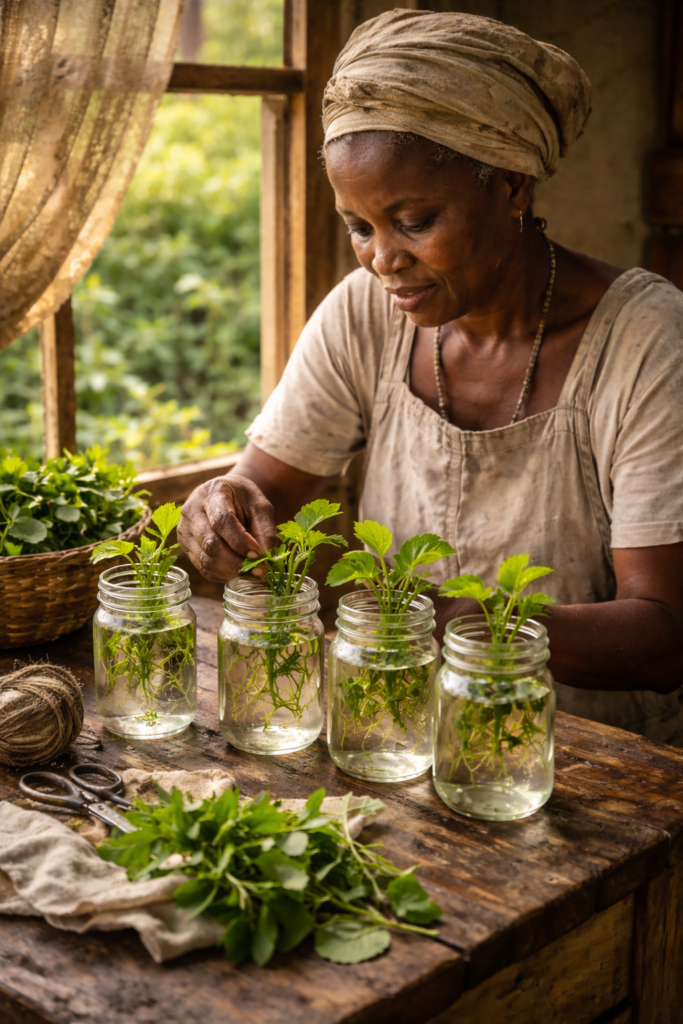
Some plants do more than grow — they travel.
They cross oceans, cultures, mountains, and the memories of women who carried them carefully from one life chapter to another. Dog Blood Herb (Rivina humilis), known for its deep connection to women’s healing, is one of those sacred travelers.
Its story in our family begins in the late 1800s, below Big A Mountain, up through Harris Holler, with a gift offered at first light…
THE STORY OF HOW DOG BLOOD HERB CAME INTO OUR FAMILY
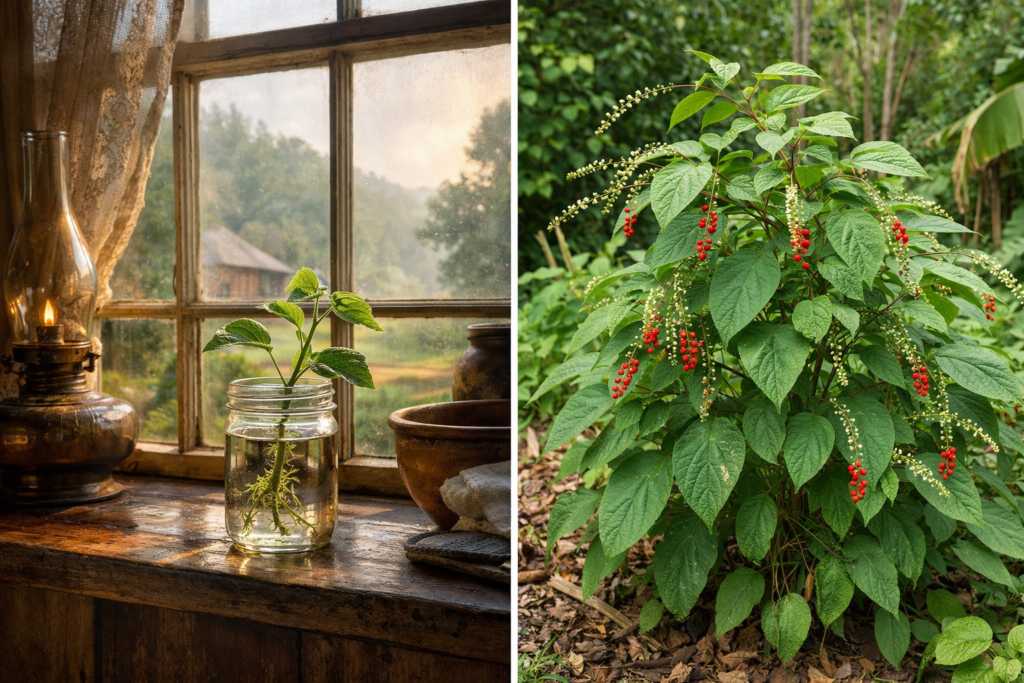
In the late 1800s, Helen Honaker lived in a quiet rise below Big A Mountain, where the mist hung low each morning and neighbors knew one another by footstep long before a knock.
One morning, just as the sun was barely warming the ridgeline, a Jamaican lady from the Harris farm down the mountain walked up to Helen’s porch. She came to help with the garden harvest — apron tied, hair wrapped, ready to work the way women did in that era: steady, willing, and without fuss.
But before they picked a single bean, she smiled gently and said:
“Miss Helen, I brought you something. Better get it in water so it don’t wilt.”
From her basket she lifted a tiny herb cutting wrapped in damp cloth — tender, pale green in the cool morning light. She placed it in Helen’s hands with a reverence that told Helen this was no ordinary plant.
“This one’s for the women,” she said.
“Keep it warm. Keep it near the light. It’ll serve you well.”
She explained how, in Jamaica, the herb was used to:
- Cleanse the womb
- Strengthen a woman after childbirth
- Ease inflammation
- Balance monthly cycles
- Support fertility and recovery
Helen listened with the quiet respect mountain women give to another woman’s ancestral knowledge.
Before heading to the garden, she placed the cutting in water by the window — the first step in what would become a generational legacy.
Helen grew it in her warmest room, where the large windows spilled sunlight onto the floor. She later put it into a 5 gallon lard bucket full of good dark dirt from out back in the yard and babied that plant like no other… It couldn’t take the harsh cold outside but she knew the value of it and kept it safe and healthy inside the house all year.
When Helen passed, the plant stayed — moving next into the hands of Lucy, her granddaughter… and eventually into mine. Maw (Lucy,, my grandmother) told me the story that I’m telling you. Maw taught me to get starters going in multiple pots so if one died, we’d have backup and that is what she did herself for years… I’m doing the same…
To this day, that precious plant still grows in the window of my home, carrying with it the strength, memory, and resilience of every woman who tended it before me. No matter where I move, it goes with me… I keep it alive.
WHAT EXACTLY IS DOG BLOOD HERB?
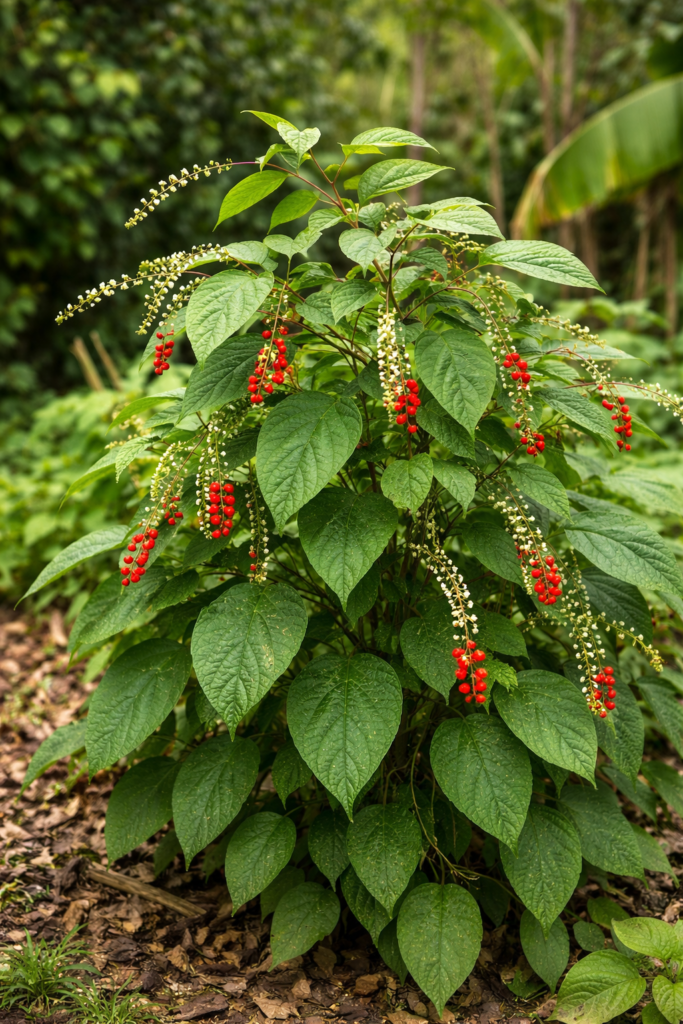
Botanical name: Rivina humilis
Common names:
- Dog Blood
- Bloodberry
- Baby Pepper
- Rouge Plant
- Pigeonberry
Regions where it naturally grows:
- Jamaica
- The Bahamas
- Trinidad & Tobago
- Central America
- Mexico
- Parts of South America
- Southern U.S. (Texas, Florida)
It thrives in warm, semi-shaded environments — and will grow indoors up North if you give it:
- Bright light
- Warmth
- A place to climb
- Moist but not soggy soil
Its berries are bright red (hence the “blood” name), though they are not used in herbal medicine.
It’s the leaves and sometimes stems that carry medicinal value.
TRADITIONAL JAMAICAN USES OF DOG BLOOD HERB
In Jamaican folk medicine — especially among midwives and older healing women — Dog Blood is considered a womb healer.
Traditional uses:
✔ Womb cleansing
✔ Menstrual regulation
✔ Supporting fertility
✔ “Cooling” inflammation
✔ Easing painful cycles
✔ Clearing “bad blood” after miscarriage (traditional belief)
✔ Helping with blocked fallopian tubes (traditional, not proven by medical research)
✔ Pelvic inflammatory discomfort
✔ Uterine strengthening after childbirth
It is often paired with:
- Strongback
- Jack-in-the-Bush
- Search-me-Heart
- Guinea Hen Weed
The herb is gentle but effective — and used with deep respect.
HOW DOG BLOOD HERB WAS USED AROUND THE WORLD
Though Jamaica is its most famous home, Rivina humilis appears in folk medicine from:
Central & South America
- Leaf teas for pain and swelling
- Poultices for skin irritations
- Mild internal cleansing
Mexico
- Decoctions for digestive upset
- Anti-inflammatory herb for “female disorders”
The American South
- Women used teas for menstrual support
- Midwives used it postpartum
- Some communities used it for general “blood cooling”
HERBAL COMPONENTS (What’s inside the plant?)
Dog Blood Herb contains:
- Flavonoids – reduce inflammation
- Saponins – help cleanse tissues gently
- Alkaloids – believed to affect smooth muscle (womb)
- Tannins – astringent, cleansing
- Phenolic acids – antioxidant, restorative
These compounds are why Jamaican healers trust it for:
- Pelvic congestion
- Menstrual imbalance
- Post-miscarriage or postpartum cleansing
It is mild but steady in its action.
HOW TO PREPARE DOG BLOOD HERB
Dog Blood Herb Tea (Traditional Jamaican Method)
Ingredients:
- 1 handful fresh leaves or
- 1–2 tbsp dried leaves
- 2 cups boiling water
Instructions:
- Rinse leaves gently.
- Add to a pot and pour boiling water over them.
- Steep 10–15 minutes (covered).
- Strain and drink warm.
Used for:
- Womb cleansing
- Menstrual support
- Fertility preparation
- Reducing pelvic inflammation
Traditional use pattern:
Drink once daily for 3–7 days depending on need.
Dog Blood Womb-Cleansing Decoction (Stronger version)
Ingredients:
- 1 cup fresh leaves (packed lightly)
- 3 cups water
Instructions:
- Simmer on low for 15–20 minutes.
- Strain.
- Drink ½ cup at a time.
This version is stronger and used carefully.
Dog Blood Herb Tincture
Ingredients:
- Fresh leaves, chopped
- 80–100 proof vodka
- Clean jar
Instructions:
- Pack jar loosely with leaves.
- Cover completely with alcohol.
- Store 6 weeks, shaking daily.
- Strain into dropper bottle.
Usage (traditional):
- 15–30 drops in water, once or twice a day during treatment cycles.
Poultice (External Use)
Used in Central America for swelling or cyst-like discomfort.
Instructions:
- Crush fresh leaves into a moist paste.
- Apply to skin wrapped in clean cloth.
- Leave on 20–30 minutes.
(Not widely used in Jamaica for womb issues — mainly inflammation.)
⚠️ SAFETY NOTES
Dog Blood Herb should NOT be used:
- During pregnancy
- During breastfeeding
- During clotting disorders
- Without understanding proper dosage
It is for non-pregnant women in cleansing or balancing cycles.
🏔 WHY THIS HERB MATTERS TO APPALACHIA
That wise woman from Harris Holler — did more than hand my Great Great Grandmother, Helen, a plant.
She handed her:
- Women’s medicine
- Women’s memory
- A bridge between cultures
- A living heirloom
Appalachian healing and Jamaican bush medicine have more in common than people realize:
- Both rely on the land
- Both honor women’s wisdom
- Both use story-based medicine
- Both are preserved through hands, not textbooks
This herb is a symbol of the quiet, powerful network of women who healed families behind the scenes for hundreds of years.
CLOSING: THE HERB THAT OUTLIVED THE SECRETS
Some people pass you pain.
But the good women who came before me passed me life — right in that special gifted starter plant, along with the knowledge of the healing powers of plants.
Dog Blood Herb is more than a plant.
It is proof that healing survives even when the world changes so fast we can hardly recognize it.
The Dog Blood Herb stayed.
The story stayed.
The women carried the knowledge to the next generations.
And now you, too, can carry the knowledge of this powerful herb forward. This is the perfect example of how the good ol’ mountain granny medicine women were so good at healing… They had ways of reaching out to folks around the world for a variety of healing plants, and they grew them on the porch or inside the house if the temperature outside wasn’t suitable for them to survive. They were always looking for a plant that could heal better than the ones that grew around them. If local folks found a rare plant during their travels or in communicating with others, they’d get a starter from it and bring it straight back to their local medicine granny on the mountain… That was just the way times were back then… My 2nd great-grandmother was known for her healing abilities and well respected for her time. Folks brought her starters all the time…
If you enjoy stories like this, you’ll love the other life lessons & memories I’m sharing on The Appalachian Sage. …………And if you’re ever in the mood to browse something pretty, you can stop by my Etsy shop, The Appalachian Sage Shop, where I pour the same love and kindness into each design.