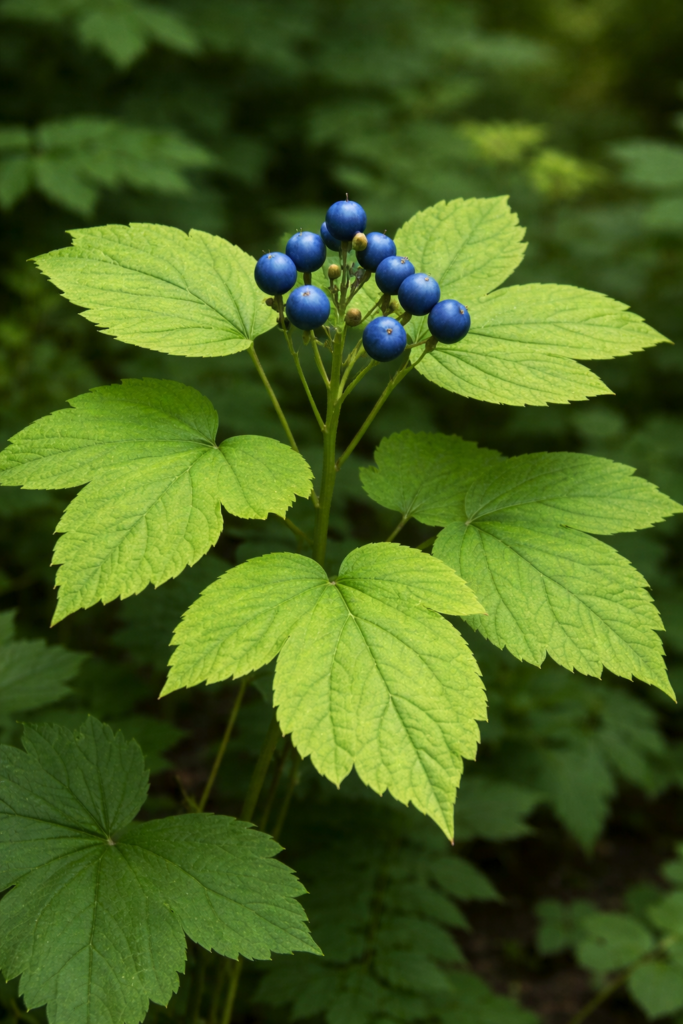
Blue Cohosh (Caulophyllum thalictroides) is one of the most misunderstood plants in American herbal medicine. Often mentioned alongside Black Cohosh, it is sometimes assumed to have similar uses. In truth, these two plants are not interchangeable.
Blue Cohosh is a strong, root-based medicine traditionally associated with childbirth, uterine activity, and deep muscular tension. It is not gentle, not nutritive, and not meant for casual or unsupervised use.
This is a plant that requires knowledge, restraint, and respect.
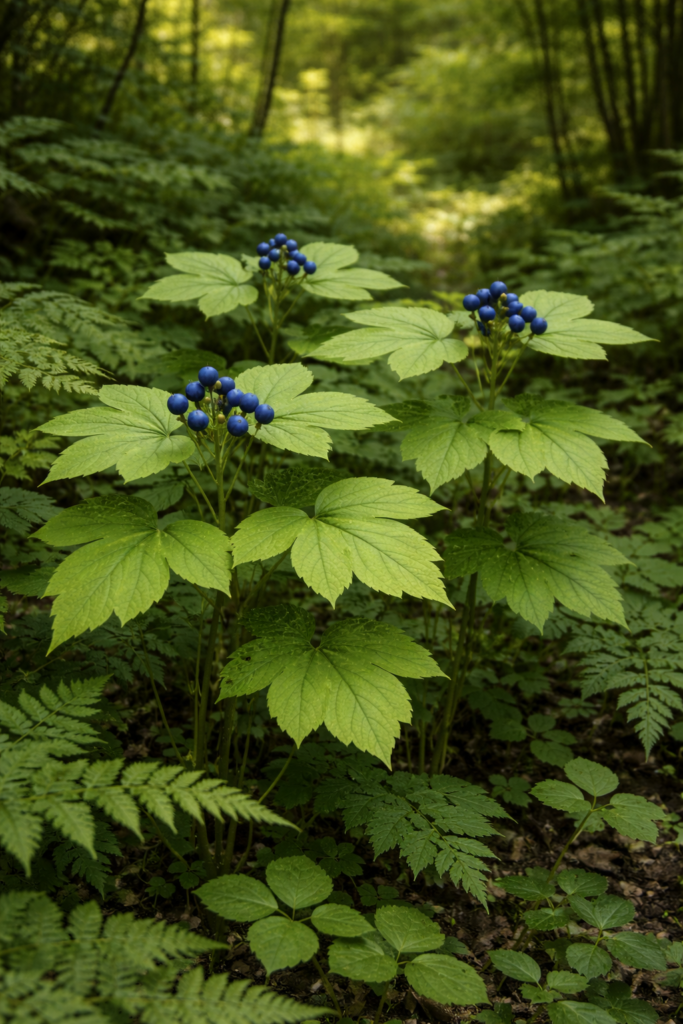
Botanical Overview
- Botanical name: Caulophyllum thalictroides
- Family: Berberidaceae (barberry family)
- Common names: Blue Cohosh, Papoose Root, Squaw Root (historical name)
- Native range: Eastern North America, including Appalachia and Kentucky
Blue Cohosh is a woodland perennial with:
- Blue-green, divided leaves
- Small yellow-green flowers
- Distinctive deep blue berries (not used medicinally)
The root and rhizome are the medicinal parts.
Indigenous & Traditional Use
Blue Cohosh was used by several Native American nations, including the Iroquois and Algonquin, primarily within midwifery traditions.
Historically, it was used:
- To support labor when contractions were weak or ineffective
- To address uterine atony
- For deep pelvic or muscular tension
- Occasionally for rheumatic pain
Importantly, it was used by experienced healers, not as a home remedy.
Core Traditional Actions
Blue Cohosh has been described as:
- Uterine stimulant
- Antispasmodic (at specific doses)
- Smooth muscle regulator
- Emmenagogue
- Peripheral circulatory stimulant
Unlike Black Cohosh, which relaxes and regulates, Blue Cohosh activates and strengthens uterine contractions.
Chemical Components (Expanded)
Blue Cohosh’s activity is explained by a combination of alkaloids and saponins, which act strongly on smooth muscle and the cardiovascular system.
1. Quinolizidine Alkaloids
Including:
- N-methylcytisine
- Sparteine-like compounds
Actions:
- Stimulate smooth muscle contraction
- Affect cardiovascular tone
- Influence neuromuscular signaling
These compounds are responsible for Blue Cohosh’s uterotonic effects.
2. Saponins
Notably:
- Caulosaponin
Actions:
- Affect smooth muscle responsiveness
- Influence circulation
- Enhance absorption of other compounds
Saponins contribute to both the effectiveness and the risk profile of the plant.
3. Resins & Glycosides
These contribute to:
- Long-lasting muscular effects
- Deep tissue engagement
- Systemic action rather than localized relief
Preparations & Historical Use
🌿 Decoction (Traditional)
- Root simmered gently
- Used in very small quantities
- Typically short-term
🌿 Tincture (Modern)
- Allows precise dosing
- Preferred in professional practice
- Still used sparingly and with caution
Blue Cohosh was never a daily tonic, never brewed casually, and never taken long-term.
Food Use: None
Blue Cohosh is not a food plant.
- It is not eaten
- It is not brewed as a beverage
- It is not used in culinary traditions
Any suggestion otherwise is inaccurate and unsafe.
Safety & Critical Cautions
This section matters.
Blue Cohosh:
- Is not safe for casual use
- Should never be used without professional guidance
- Is contraindicated in pregnancy except under trained supervision
- Can affect heart rate and blood pressure
- Has been associated with adverse outcomes when misused
Modern clinical literature emphasizes extreme caution, especially during pregnancy.
This plant’s historical use does not equal modern safety for unsupervised use.
Why Blue Cohosh Still Appears in Herbal Literature
Blue Cohosh remains relevant because:
- It illustrates the depth of traditional midwifery knowledge
- It demonstrates that not all herbs are “gentle”
- It reminds modern readers that plant medicine includes powerful pharmacological agents
It is studied today primarily as a historical and clinical reference, not as a self-care herb.
Blue Cohosh vs Black Cohosh (Brief Clarification)
- Black Cohosh: Regulating, calming, nervine, anti-inflammatory
- Blue Cohosh: Stimulating, uterotonic, activating, high-risk
They serve entirely different purposes and should not be confused.
Final Reflection
Blue Cohosh is not a plant of comfort — it is a plant of force and function. It was used at moments when the body needed help completing a process it could not finish alone.
Its continued presence in herbal literature is a reminder that traditional medicine was not simplistic. It required training, responsibility, and ethical judgment.
Blue Cohosh teaches one of the oldest lessons in herbalism:
Power without wisdom is dangerous.
Wisdom without restraint is incomplete.
Blue Cohosh Berries: Are They Poisonous?
The berries of Blue Cohosh are considered toxic and are not edible.
- They contain alkaloids and saponins that can irritate the digestive system and affect the heart and nervous system.
- There is no traditional food use for the berries.
- They were never used medicinally in Indigenous or traditional herbal practice.
- Ingestion can cause nausea, vomiting, dizziness, and other adverse effects.
The berries are best understood as ornamental and botanical identifiers only — not medicine and not food.
👉 Bottom line:
Do not eat the berries.
Blue Cohosh Leaves: Are They Poisonous?
The leaves are not used as food and are generally avoided, but they are less toxic than the berries.
- Leaves contain some of the same active compounds as the root, but in lower concentrations.
- They were not traditionally harvested or prepared for internal use.
- While touching the leaves is safe, they are not edible greens like dandelion or chickweed.
Some sources describe the leaves as mildly toxic if consumed, especially in quantity.
👉 Bottom line:
Do not eat the leaves.
What Part Was Used Traditionally?
Only the root and rhizome were used medicinally — and even then:
- In very small amounts
- For specific situations
- By experienced practitioners
This distinction matters.
Many medicinal plants have:
- ✖️ Toxic berries
- ✖️ Non-edible leaves
- ✔️ Medicinal roots (when used correctly)
Blue Cohosh is one of them.
Beginner Takeaway
For someone new to herbs:
- Blue Cohosh is a plant to study, not experiment with
- It is not a wild edible
- It is not safe for casual use
- Its beauty in the woods does not equal gentleness
Learning which parts of a plant are used — and which are avoided — is a core skill in herbalism.
Blue Cohosh in Appalachian Folk Practice & “Granny” Traditions
In Appalachian folk tradition, Blue Cohosh occupied a quiet but serious place. It was not an herb for casual use, nor one spoken of lightly. Among Appalachian “granny women,” root workers, and those later labeled as witches by outsiders, Blue Cohosh was understood as strong women’s medicine—used sparingly, privately, and only when truly needed.
These practitioners did not separate herbal knowledge from intuition, prayer, or responsibility. Blue Cohosh was respected as a plant that influenced deep bodily forces, especially those tied to the womb, muscles, and cycles of birth. Because of its strength, it was never treated like a tonic or everyday tea. It was a plant brought out only at threshold moments, when gentler remedies were insufficient.
How It Was Viewed
In Appalachian folk belief, Blue Cohosh was associated with:
- Initiation and transition
- Childbirth and recovery
- Deep pelvic or muscular tension
- Moments when the body was “stuck” and needed assistance to complete a process
Rather than forcing outcomes, folk practitioners believed the plant helped the body finish what it had already begun. This belief echoed older Indigenous teachings that illness and labor were processes to be supported, not overridden.
Use Within a Closed Circle
Blue Cohosh was rarely shared widely. Knowledge of it stayed within:
- Family lines
- Trusted midwives
- Root workers with lived experience
Its preparation and use were often accompanied by:
- Quiet prayer
- Focused intention
- Timing tied to the body’s natural rhythms
This was not superstition but risk awareness. Appalachian healers knew that power without restraint caused harm, and Blue Cohosh demanded restraint.
Why It Was Feared as Much as Respected
As outside authorities pushed formal medicine into the mountains, herbs like Blue Cohosh became targets of suspicion. Because it affected childbirth and women’s bodies—areas already controlled and policed—its use was increasingly labeled dangerous or immoral when practiced outside institutional medicine.
This led to:
- Loss of oral knowledge
- Fear-based stories replacing nuance
- Confusion between Blue Cohosh and gentler herbs
Yet within families that remembered, the lesson remained:
“Some plants are not bad — they are just not for everyone.”
A Plant of Responsibility, Not Rebellion
Appalachian folk healers did not see Blue Cohosh as a rebellious herb. They saw it as a responsibility herb—one that demanded maturity, discernment, and humility.
It was not used to defy nature, but to assist it carefully.
Modern Reflection
Today, Blue Cohosh stands as a reminder that traditional Appalachian practice was not reckless or naïve. It was precise, conservative, and deeply ethical. The plant’s history teaches modern learners an essential lesson:
Not all herbal knowledge is meant for casual use.
Some knowledge exists to remind us of our limits.

Why Blue Cohosh Was Used in Childbirth (Historically)
Appalachian midwives did not use Blue Cohosh to start labor casually, speed things up for convenience, or interfere with a normal birth.
They used it only when labor had already begun and the body was failing to complete the process on its own.
That distinction matters.
What Was the Problem They Were Addressing?
In traditional childbirth settings, a common and dangerous situation was:
- Labor had clearly begun
- The cervix had started to open
- Contractions were present
- But contractions were weak, irregular, or ineffective
- The uterus was “tired,” tense, or uncoordinated
This is what folk midwives described as:
- “The womb not taking hold”
- “Labor stuck”
- “Pains not doing their work”
Before hospitals, prolonged labor could be fatal — for mother or baby.
What Blue Cohosh Was Believed to Do (Exactly)
Based on traditional understanding and modern phytochemistry, Blue Cohosh was believed to act in three key ways:
1. It Stimulated Uterine Muscle Contraction
Blue Cohosh contains alkaloids and saponins that affect smooth muscle, especially the uterus.
Traditionally observed effects:
- Strengthened contractions when they were too weak
- Made contractions more coordinated
- Helped the uterus “commit” to the labor process
This is why it is classified as a uterotonic (uterine-strengthening herb).
2. It Helped the Uterus Move From “Tense” to “Effective”
This may sound contradictory, but it was a crucial insight.
Midwives noticed that some labors weren’t slow because the uterus was weak — but because it was tight, spasmodic, and inefficient.
Blue Cohosh was believed to:
- Reduce spasmodic, cramping-type contractions
- Replace them with stronger, more purposeful contractions
- Help the uterus work rhythmically instead of chaotically
In modern terms, it influenced neuromuscular coordination.
3. It Helped the Body Finish What It Had Already Started
This is the most important point.
Blue Cohosh was not used to force labor.
It was used when:
- Labor was already underway
- The body had clearly initiated the process
- But lacked the strength or coordination to finish
Midwives believed the plant helped the uterus complete an existing physiological process, rather than override it.
Why It Was Used With Extreme Caution
Appalachian midwives were well aware that:
- Too much could cause overly strong contractions
- Poor timing could create danger
- Using it too early could cause harm
That’s why:
- It was used only by experienced hands
- Knowledge was passed quietly, not publicly
- It was never a “home remedy”
- It was never given routinely
This caution is echoed in modern medical literature, which recognizes Blue Cohosh as pharmacologically active and potentially dangerous if misused.
Why This Knowledge Was Lost or Feared
As childbirth moved from homes to hospitals:
- Traditional midwifery knowledge was discredited
- Herbs affecting labor became taboo
- Context was lost, leaving only warnings behind
Without the when, why, and how, Blue Cohosh became either:
- Romanticized dangerously
- Or rejected entirely
Both miss the truth.
The Truth in Plain Language
Appalachian midwives used Blue Cohosh because:
It helped a laboring uterus contract more effectively when labor was already underway but failing to progress — and only when gentler measures had failed.
That’s it.
No mysticism. No recklessness. No casual use.
Why This Matters Today
Understanding why it was used teaches an essential lesson in herbalism:
Powerful plants are not bad — they are specific.
Specific plants require specific situations, timing, and wisdom.
Blue Cohosh wasn’t used because midwives were reckless.
It was used because they were trying to save lives with the tools they had, and they understood the difference between supporting a process and forcing one.
Educational Disclaimer
This article is provided for educational and historical purposes only. It is not intended to diagnose, treat, cure, or prevent any disease. Blue Cohosh is a powerful plant that should not be used without professional guidance. Always consult a qualified healthcare provider before using herbs, especially during pregnancy, while taking medications, or when managing a medical condition.
If you enjoy stories like this, you’ll love the other life lessons & memories I’m sharing on The Appalachian Sage. …………And if you’re ever in the mood to browse something pretty, you can stop by my Etsy shop, The Appalachian Sage Shop, where I pour the same love and kindness into each design.