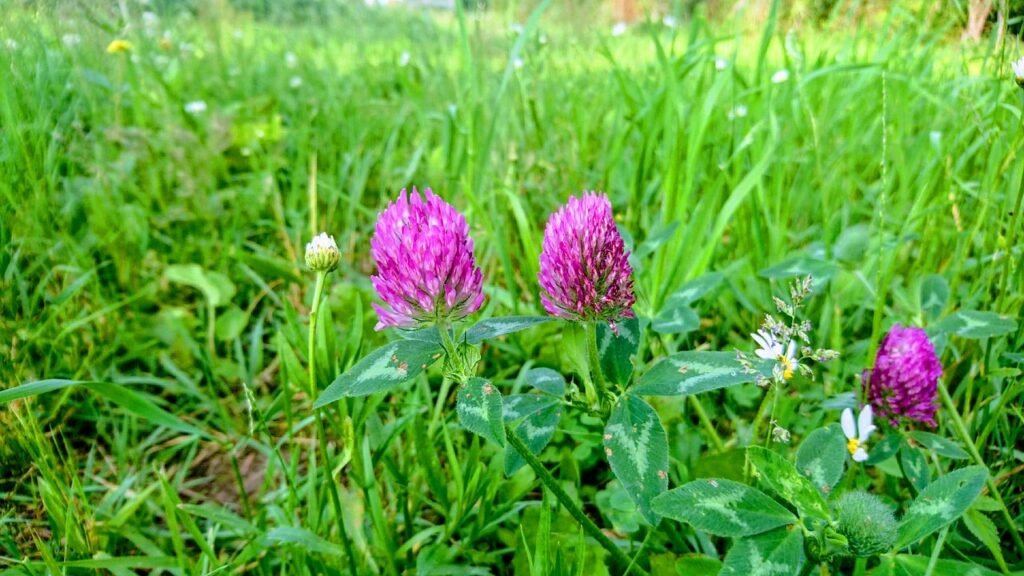
Common name: Red Clover
Latin name: Trifolium pratense
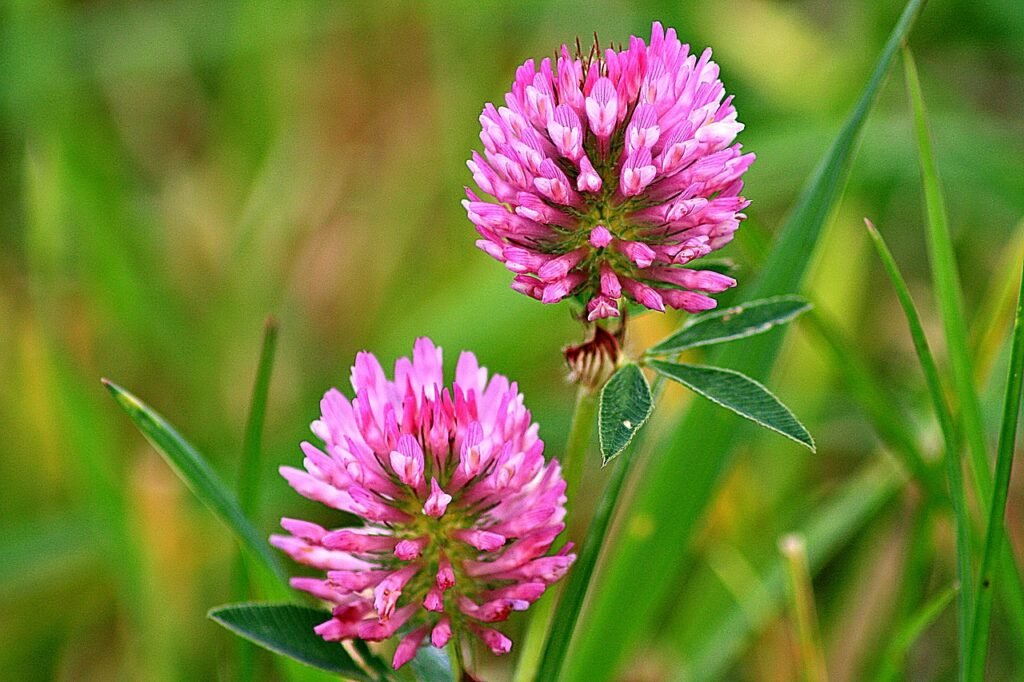
Red clover is a short-lived perennial in the pea family (Fabaceae). It’s the pink-purple clover you see dotting hayfields, pasture edges, and roadside banks, with a little “bee magnet” flower shaped like a rounded pom-pom.
Where Red Clover Grows
Red clover is native to Europe, Western Asia, and parts of North Africa, but it’s now naturalized across:
- North America – especially the U.S. and Canada in hay fields and pastures
- Europe – widely cultivated as a forage and cover crop
- New Zealand & Australia – grown for livestock feed and soil improvement
- Temperate regions worldwide – thrives in cool, moist climates and well-drained soils
Because it’s a nitrogen-fixing legume, farmers sow red clover as a cover crop to enrich tired soil, prevent erosion, and feed the next planting with slow, natural nitrogen.
Main Constituents of Red Clover (and What They’re Studied For)
Red clover has a very “busy” chemistry. The exact amounts vary with soil, climate, and harvest time, but here are the big players people usually talk about:
1. Isoflavones
Key isoflavones in red clover include formononetin, biochanin A, genistein, and daidzein. These are sometimes called “phytoestrogens” because they can weakly interact with estrogen receptors.
- Traditionally, this is why red clover shows up in folk blends used to support women through mid-life changes (hot flashes, mood changes, etc.), although research results are mixed and still ongoing.
- Some herbal traditions also pair red clover with other “balancing” herbs to support a general sense of hormonal comfort and well-being, not as a replacement for medical treatment.
2. Flavonoids & Polyphenols
Red clover flowers contain a variety of flavonoids and antioxidant compounds.
- These are being studied for general cell-protective and oxidative-stress-modulating effects.
- In folk practice, this is part of why red clover is added to “blood-cleansing” or “spring tonic” formulas to support overall vitality.
3. Coumarins
Red clover contains small amounts of coumarins, aromatic compounds that can have a mild effect on circulation and blood properties.
- Because of this, many herbalists use red clover more carefully if someone is already on blood-thinning medications or has a bleeding disorder—something to discuss with a qualified practitioner before heavy use.
4. Tannins
These astringent compounds give clover a slightly drying, tightening quality.
- In traditional external use, tannins are part of why red clover has been applied to minor skin irritations in poultices, washes, and salves.
5. Vitamins & Minerals
Red clover leaves and blossoms are rich in nutrients, especially when eaten fresh or lightly cooked:
- Vitamins: A (as carotenoids), C, some B-vitamins
- Minerals: calcium, magnesium, potassium, chromium, and trace amounts of others
- Protein: like other legumes, it has a modest protein content, which is why it’s valued as animal forage
This nutrient profile is why traditional country folk often used red clover leaf in spring greens and light broths to “build the blood” and refresh the body after a long winter.
Traditional & Cultural Uses
European Folk Traditions
In European country medicine, red clover flowers were often:
- Added to spring tonics with dandelion leaf, nettles, and burdock for general cleansing
- Used as a mild expectorant tea to help soothe the chest and throat during seasonal discomfort
- Included in “blood-purifying” blends drunk over weeks to support skin clarity and overall vitality
Old herbals sometimes mention red clover as a “herb for the whole constitution,” used gently over time rather than as a quick, dramatic remedy.
North American Folk & Eclectic Herbalism
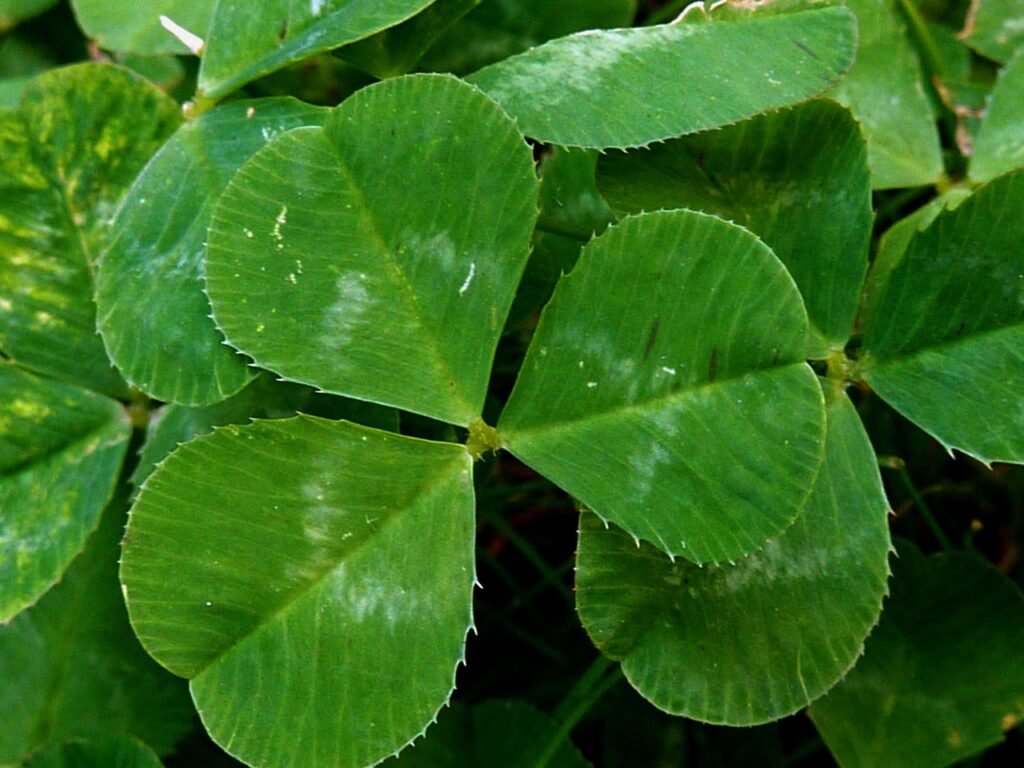
Red clover made its way into North American eclectic herbal practice (late 1800s–early 1900s).
- It appears in formulas that were used traditionally to support lymphatic health and general resilience when someone felt run down.
- Many “alterative” (deep-support) herbal formulas paired red clover with burdock root, yellow dock, and other tonics.
You’ll find red clover mentioned in older herbal texts as a plant to be used long-term under guidance for “stubborn” internal imbalances—again, described in constitutional, not modern diagnostic, language.
Food Uses
In many rural cultures, red clover wasn’t just a medicinal; it was food:
- Fresh blossoms were sprinkled into salads or used as pretty edible garnishes.
- Leaves and young tops were lightly steamed or sautéed along with other wild greens.
- Some folks dried the blossoms and crumbled them into breads or grain dishes for color and nutrition.
As always with wild edibles: proper identification, clean harvesting areas, and moderation are key.
Simple Red Clover Preparations
Always check with a qualified practitioner if pregnant, breastfeeding, taking hormones, blood thinners, or if you have a hormone-sensitive condition. Red clover may not be appropriate for everyone.
1. Red Clover Tea (Infusion)
A classic way to enjoy the blossoms.
Ingredients
- 1–2 tsp dried red clover blossoms (or 2–3 Tbsp fresh)
- 8–10 oz just-off-boiling water
- Optional: a little mint, lemon balm, or chamomile, and honey to taste
Directions
- Place blossoms in a heat-safe mug or teapot.
- Pour hot water over and cover with a saucer or lid.
- Steep 10–15 minutes, then strain.
- Sip warm.
Traditionally, this mild tea was drunk 1–3 times per day in short seasonal “courses” to support general well-being.
2. Red Clover Tincture (Folk Method)
This is for educational purposes; anyone making tinctures should understand basic herbal safety, clean equipment, and local laws.
Ingredients
- Fresh or thoroughly dried red clover blossoms
- 80-proof (40%) vodka or other neutral alcohol
- Glass jar with lid, label
Directions (Folk Strength)
- Fill a clean jar ½–¾ full with lightly packed blossoms.
- Cover completely with alcohol, making sure herbs are submerged.
- Cap tightly, label with date and plant name.
- Store in a cool, dark place for 4–6 weeks, shaking gently every few days.
- Strain through cheesecloth, bottle the liquid in amber jars, and label.
Traditionally, small dropper amounts of a tincture like this might be taken in water as part of a practitioner-guided protocol.
3. Red Clover Skin Oil & Salve
This keeps things in the “comfort & cosmetic” lane.
Infused Oil
- Fill a clean, dry jar halfway with thoroughly dried red clover blossoms.
- Cover with a carrier oil (olive, sweet almond, jojoba). Stir to release air bubbles.
- Cap and let infuse 4–6 weeks in a cool, dark place, or use a gentle “warm infusion” by setting the jar in a warm (but not hot) water bath for several hours over a few days.
- Strain and label.
Simple Salve
- 1 cup red clover infused oil
- 1 oz beeswax pellets (adjust for softness)
- Gently warm the oil in a double boiler.
- Add beeswax and stir until melted.
- Pour into tins or jars and let cool.
Herbalists often combine this type of salve with calendula, plantain, or violet leaf oils for a multi-herb “comfort balm” for minor skin dryness and rough patches.
4. Simple Red Clover Food Recipes
Red Clover Blossom Honey
- Fill a jar loosely with fresh, dry-surface blossoms (no dew).
- Pour raw honey over, stir to remove air pockets.
- Cap and let infuse 2–4 weeks, turning the jar occasionally.
- Strain if desired.
Lovely stirred into tea or drizzled over biscuits, pancakes, or yogurt.
Spring Tonic Greens (Kitchen Folk Style)
- Equal parts chopped red clover leaves, nettles, and dandelion greens
- Olive oil or butter, garlic, pinch of salt, squeeze of lemon
- Blanch the wild greens briefly in boiling water, then drain.
- Sauté in a skillet with oil/butter and minced garlic for 3–5 minutes.
- Finish with a squeeze of lemon and sprinkle of salt.
This style of dish shows up in many rural cuisines as a way to wake up the body after winter with mineral-rich wild greens.
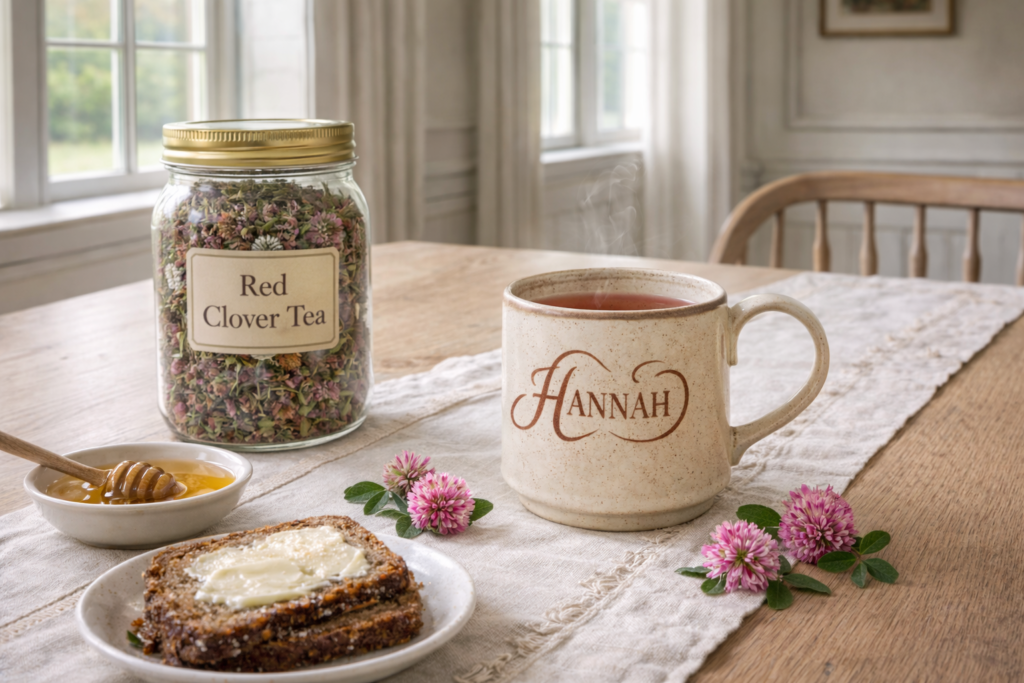
Nordic Country–Style Red Clover & Honey Tea
This is inspired by old Northern European / Scandinavian farmhouse teas, but plated like it’s being served in a quiet, upper-class country manor.
Ingredients (1 large mug or 2 small cups)
- 2 Tbsp fresh red clover blossoms
– or 1 Tbsp dried blossoms - 1 tsp dried lemon balm or a strip of fresh lemon peel (optional, for softness)
- 8–10 oz just-off-boiling water
- 1–2 tsp raw honey (lighter floral honey if you have it)
- Tiny squeeze of fresh lemon juice (optional)
Safety note: Red clover may not be appropriate in pregnancy, for people on blood-thinning meds, or with hormone-sensitive conditions. Anyone in those categories should talk to a qualified practitioner first.
Directions
- Prepare the blossoms
- If fresh, gently shake off any insects and remove tough stems.
- If dried, measure out your tablespoon and pop it into a fine mesh strainer or tea infuser.
- Steep the tea
- Place red clover (and lemon balm or peel, if using) into a teapot or heat-safe mug.
- Pour 8–10 oz of just-off-boiling water over the herbs.
- Cover with a lid or saucer and let steep 10–15 minutes for a soft, floral cup.
- Strain into your prettiest handmade mug.
- Finish with honey & lemon
- Stir in honey to taste.
- Add a tiny squeeze of lemon juice if you like a brighter, more “Nordic spring” flavor.
- Serve it manor-style
- Set the mug on a small saucer.
- Add a plate with a thin buttered slice of dark rye or seeded bread, drizzled with a little red clover blossom honey if you’ve made some.
- Garnish the tray with one fresh red clover blossom for color.
Synergy: Red Clover with Other Herbs
Herbalists often work with combinations rather than single herbs. A few traditional pairings (for folks to research further on their own):
- Red Clover + Burdock Root – often used together in “deep-support” or “alterative” formulas to support digestion, elimination, and general vitality over time.
- Red Clover + Nettle Leaf – a mineral-rich pairing for nourishing teas and broths.
- Red Clover + Yellow Dock Root – shows up in some historical blends aimed at supporting skin health and regular elimination.
These combinations are part of older traditions and should not replace medical care. They’re best explored in conversation with a skilled herbal practitioner who can look at the whole person, not just a single symptom.
A Gentle Nudge Toward Further Research
Red clover has walked alongside farmers, foragers, and village healers for centuries—as forage for animals, food for people, and a folk remedy woven into spring tonics and gentle long-term formulas.
Modern scientists are still untangling the exact roles of its isoflavones, flavonoids, and other compounds, and how they might support different aspects of human health. For anyone curious, digging into reputable herbal texts, pubmed studies, and the writings of experienced clinical herbalists can open up a whole world of deeper understanding.
If you enjoy stories like this, you’ll love the other life lessons & memories I’m sharing on The Appalachian Sage. …………And if you’re ever in the mood to browse something pretty, you can stop by my Etsy shop, The Appalachian Sage Shop, where I pour the same love and kindness into each design.