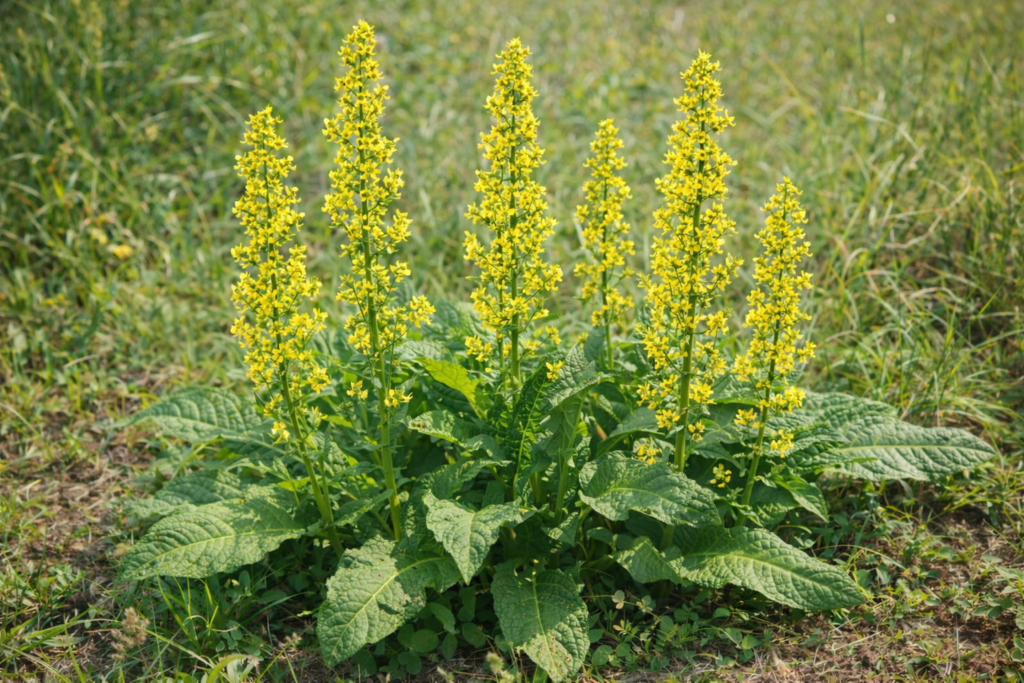
Botanical ID & Names
- Common names: Yellow dock, curly dock, curled dock
- Latin name: Rumex crispus
- Family: Polygonaceae (same family as sorrel and buckwheat)
Yellow dock is a perennial with:
- A deep yellow taproot (that’s where the name comes from)
- A basal rosette of long, narrow leaves with wavy/curled edges
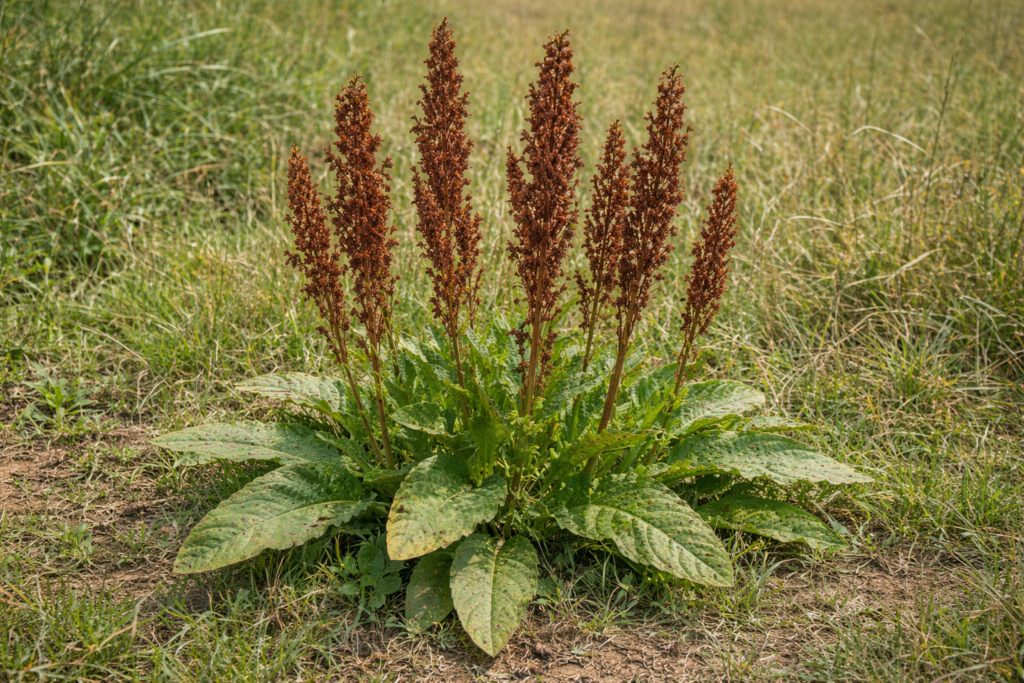
- A tall flower/seed stalk that can reach up to ~1–1.5 m
- Rusty-brown seed clusters that stay on the stem into winter
It’s native to Europe and Western Asia, but it has naturalized across North America, South America, North Africa, New Zealand, Australia, and much of temperate Eurasia. In many places it’s considered an invasive or noxious weed, thriving in disturbed soils, roadsides, pastures, and field edges.
Where Yellow Dock Grows & Cultural Use Around the World
Because Rumex crispus loves disturbed ground, you’ll find it:
- Along roadsides and railways
- In pastures and barnyards
- Around waste ground, field edges, riverbanks, and damp low spots
Europe & Western Asia
In Europe and Western Asia, yellow dock and its cousins have been used as:
- Spring “blood cleansers” and alteratives
- Mild laxatives and digestive bitters
- Remedies for skin conditions thought to stem from “bad blood” – chronic rashes, eczema, boils
In some regions (e.g., parts of Italy, Armenia, and Eastern Europe), the young leaves or stalks have been eaten as cooked greens or mixed into soups, similar to sorrel, though they’re too bitter/oxalic to use in big amounts.
North America
Native American and settler herbalists used yellow dock root as a:
- “Blood purifier” and liver tonic
- Mild laxative
- Remedy for skin eruptions (internally and topically)
- Poultice for sores, infections, and rashes
In modern Western herbalism it’s still one of the core “alterative” herbs to support digestion, liver function, and chronic inflammatory skin issues, especially when sluggish bowels or low iron are part of the picture.
Asia & Other Regions
Reviews note that Rumex crispus is used across Turkey, Korea, China, Serbia, and other parts of Asia for:
- Digestive complaints
- Mild diabetes
- Liver and gallbladder issues
- Hemorrhoids and bleeding
- “Blood cleansing” and general tonic use
Key Constituents of Yellow Dock (and What They Do)
Modern analysis has identified over 200 compounds in R. crispus root and aerial parts.
The main groups that herbalists care about:
- Anthraquinone glycosides
- Examples: emodin, chrysophanol and related hydroxyanthracene derivatives
- Traditional view: Provide a mild to moderate laxative effect, helping move the bowels.
- Experimental findings: Anthraquinones in Rumex species show laxative, antimicrobial, anti-inflammatory, and antitumor activities in lab and animal models, but this doesn’t translate into proven cancer treatments in humans.
- Tannins (polyphenolic compounds)
- Astringent, “tightening” effect on tissues.
- Help explain traditional use for diarrhea, hemorrhoids, and minor bleeding.
- Flavonoids & phenolic acids
- Strong antioxidant and anti-inflammatory actions in vitro.
- Contribute to its classification as an alterative (systemic metabolic support herb).
- Naphthalene derivatives (e.g., nepodin)
- These are being studied for antimicrobial and metabolic effects, including possible anti-diabetic and anti-gout actions in experimental models.
- Minerals (especially iron)
- Roots are relatively rich in iron and other minerals, which is why Western herbalists often pair yellow dock with nettle in tonic formulas for low iron states.
- Oxalates (oxalic acid)
- Especially in the leaves, contributing to their sour taste and to kidney stone risk if eaten in excess, particularly in susceptible people.
- Other groups: stilbenes, coumarins, triterpenes, essential oil fraction, etc.
- These add more antioxidant, antimicrobial, and anti-inflammatory activity in lab studies.
Traditional & Modern Uses (High-Level, Not Prescriptive)
Traditional herbal roles for yellow dock root include:
- Alterative / “blood purifier” – used over time for chronic skin conditions and sluggish detox pathways.
- Liver & gallbladder support – bitter tonic used in “spring cleanses” and chronic digestive sluggishness.
- Mild laxative – especially for atonic or sluggish constipation; too much can flip into full cathartic.
- Skin support – acne, chronic rashes, “scurfy” skin, often combined with burdock, sarsaparilla, etc.
- Iron & “blood-building” tonic – frequently paired with nettle or other nutrient herbs.
Modern experimental studies (test tube and animal models) report:
- Antioxidant and antimicrobial activity from both leaves and roots
- Anti-inflammatory and potential diuretic activity of root extracts
- Possible anti-diabetic, anti-gout, and enzyme-modulating effects from isolated root constituents
- Cytotoxic/antiproliferative effects on certain cancer cell lines in vitro (e.g., colorectal adenocarcinoma), meaning extracts can push those cells toward programmed cell death in lab dishes. This is not the same as a proven cancer cure in humans.
None of this replaces standard medical care. Clinical trials in humans are still limited, and safety at medicinal doses over time hasn’t been fully mapped.

Preparations & Recipes (Educational / Folk-Style)
⚠️ Safety note for all recipes below:
These are traditional herbal preparation methods shared for educational purposes. Yellow dock can interact with health conditions and medications (especially laxatives, diuretics, iron issues, and kidney stone history). Anyone actually taking it should work with a qualified practitioner.
1. Yellow Dock Root Decoction (Tea)
Part used: Root (fresh or dried, finely chopped)
Traditional kitchen-style method:
- Place about 1 teaspoon of dried chopped root (or ~2–3 g) per 8 oz (240 ml) of water in a small pot.
- Bring to a boil, then simmer 10–15 minutes.
- Cover, let steep another 10 minutes, then strain.
- Traditionally taken in small amounts, often combined with other alteratives or bitters.
The long simmering helps pull out anthraquinones, tannins, and minerals from the tough root tissue.
2. Yellow Dock Tincture (Alcohol Extract)
Again, this is the folk herbal style, not a prescription:
- Chop fresh root or use well-dried cut root.
- Fill a glass jar about ½ full with plant material.
- Cover with 40–60% alcohol (vodka/brandy strength up to strong tincture alcohol), ensuring all plant matter is submerged.
- Label and keep in a dark place, shaking daily for 2–4 weeks.
- Strain, bottle, and label.
Herbalists use tinctures for small, repeated doses as part of alterative/liver formulas. Root tinctures concentrate anthraquinones, flavonoids, and other phenolics.
3. Decoction + Syrup or Glycerite
For a more palatable tonic:
- Make a strong decoction of yellow dock root (e.g., simmer longer and use more root relative to water).
- Strain and combine with an equal amount of honey or sugar to create a simple syrup, or
- Combine the decoction with vegetable glycerin for a glycerite (good for those avoiding alcohol).
Traditionally, such syrups might be taken in teaspoon doses for a period, often in spring or for sluggish digestion/skin, and often in combination with other herbs.
4. Infused Oil & Salve (Topical)
Infused oil:
- Use dried yellow dock root (moisture-free to avoid spoilage).
- Fill a jar about ⅓–½ full with the dried root.
- Cover with a stable oil (olive, sunflower, etc.).
- Let infuse 4–6 weeks in a warm spot, shaking daily; or gently warm in a double boiler at very low heat for several hours until infused.
- Strain through cloth and bottle.
Basic salve:
- Measure your infused oil.
- Add about 1 part beeswax to 4–5 parts oil (by weight) in a double boiler.
- Gently heat until beeswax melts, then pour into tins/jars.
- Let cool and label.
Traditionally, such salves have been used for minor skin irritations, rashes, and chronic “scurfy” conditions, often alongside internal alteratives. Always patch-test and avoid broken skin unless guided by a practitioner.
Essential Oil or Infusions?
There is an essential oil fraction in R. crispus (volatile components identified in lab analyses), but yellow dock is not commonly used as an essential oil in everyday aromatherapy the way rosemary or thyme are.
In practice, herbalists usually rely on:
- Water-based preparations (decoctions, syrups)
- Alcohol/glycerin extracts (tinctures/glycerites)
- Infused oils & salves for external use
Other Uses Beyond Medicine
Yellow dock has been used traditionally as:
- Food (with caution): young leaves and shoots, cooked like sorrel or spinach, and seeds ground into a bitter flour—always watching oxalic acid content and limiting intake.
- Natural dye: roots and seeds can produce yellow to olive tones for wool and textiles.
Yellow Dock in Modern Medicine & Pharma
You asked specifically about modern medicines that use yellow dock.
Right now:
- Rumex crispus is used widely in herbal supplements, tinctures, and tonics, often marketed for digestion, “detox,” skin support, or iron support.
- Yellow dock root is included in homeopathic pharmacopoeias and prepared as a standardized mother tincture for homeopathic use.
- Researchers are actively studying its antioxidant, anti-inflammatory, antimicrobial, anti-diabetic, and anti-gout potential in experimental models, and exploring specific compounds (like certain anthraquinones and naphthalene derivatives) as leads for future drugs. https://pmc.ncbi.nlm.nih.gov/articles/PMC6864818/
However:
There are currently no widely used, mainstream prescription drugs where yellow dock root itself is the primary approved active pharmaceutical ingredient.
Its role is mainly in herbal and nutraceutical formulas and in homeopathic preparations, not as a stand-alone conventional pharmaceutical.
So for your article, you can honestly say:
- Its constituent groups (like anthraquinones) are the same class of compounds that underpin some laxative drugs,
- but yellow dock itself is still used primarily in traditional and complementary medicine, with ongoing research into possible future pharmaceutical applications. https://todayspractitioner.com/wp-content/uploads/2024/08/Vasas-2015-genus-rumex-review-traditional-phytochemistry-pharmacology.pdf
Safety, Cautions, and Respect for the Plant
Because this weed is strong medicine, most sources recommend caution with dose and duration:
- High or long-term doses of anthraquinone-containing herbs (yellow dock, senna, cascara) can cause diarrhea, cramping, electrolyte imbalance, and possibly contribute to long-term bowel irritation. https://todayspractitioner.com/wp-content/uploads/2024/08/Vasas-2015-genus-rumex-review-traditional-phytochemistry-pharmacology.pdf
- The oxalic acid content, especially in leaves, may increase risk of kidney stones in susceptible individuals; intake should be modest in those with kidney issues. https://en.wikipedia.org/wiki/Rumex_crispus
- Some reports note potential toxicity, allergic reactions, and thrombocytopenia with certain Rumex species at higher doses. https://pubmed.ncbi.nlm.nih.gov/39520965/
- Caution is usually advised in pregnancy, breastfeeding, children, and those on multiple medications—this is where a skilled clinician really matters.
And of course:
None of this is medical advice or a substitute for a practitioner. It’s educational information for understanding the plant and its place in traditional medicine and modern research.
If you enjoy stories like this, you’ll love the other life lessons & memories I’m sharing on The Appalachian Sage. …………And if you’re ever in the mood to browse something pretty, you can stop by my Etsy shop, The Appalachian Sage Shop, where I pour the same love and kindness into each design