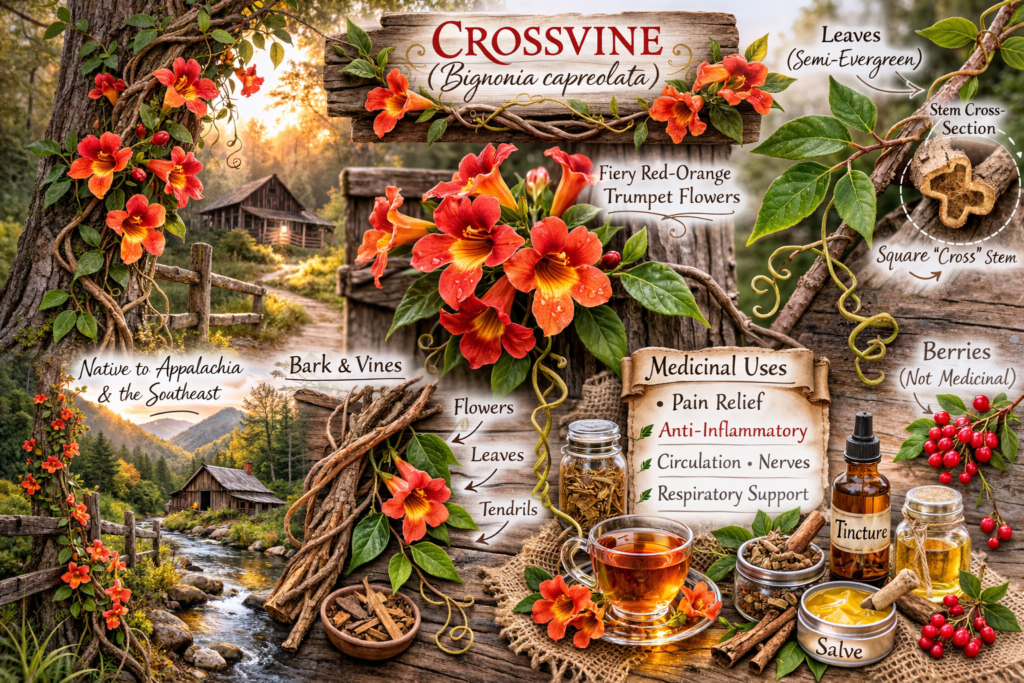
Crossvine (Bignonia capreolata) is one of the South’s most striking native plants — a semi-evergreen climber found draping over fences, climbing old barns, wrapping around forest edges, and lighting up early spring with clusters of fiery red-orange blooms.
While most people admire Crossvine for its beauty, early Appalachian communities valued it for something more:
its usefulness as a medicinal plant long before pharmacies existed.
Native to the southeastern United States, Crossvine has been used for centuries as a pain-reliever, anti-inflammatory, nerve tonic, and general restorative, especially in areas where access to doctors was limited.
This article explores the traditional uses, plant chemistry, preparations, and folklore behind this iconic Appalachian vine.
IDENTIFICATION & HABITAT
Botanical name: Bignonia capreolata
Common names: Crossvine, trumpet flower, quarter-vine
Key identifying features:
- A climbing vine that can reach 30–50 feet
- Semi-evergreen leaves
- Brilliant red, orange, and yellow trumpet flowers in early spring
- Square-shaped stem cross-section (forms a natural “cross,” which gives the name)
- Tendrils with adhesive pads allowing it to climb trees and structures
Crossvine grows throughout Appalachia, the Deep South, and into Texas — thriving in woodland edges, hollers, creek banks, and abandoned homesteads.
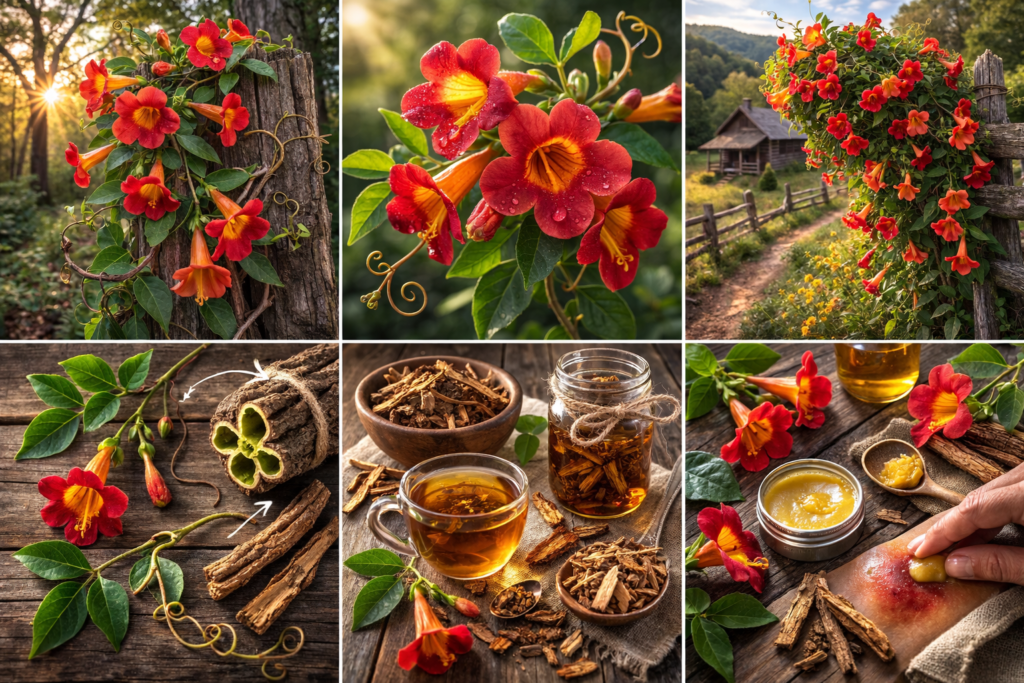
TRADITIONAL APPALACHIAN USES OF CROSSVINE
Long before modern medicine, rural mountain settlers and Indigenous tribes used Crossvine as a versatile healing plant.
Most common traditional uses:
- Pain relief (general pain, headaches, joint pain)
- Anti-inflammatory support
- Soothing nerves and easing tension
- “Spring tonic” for fatigue and weakness
- Increasing circulation
- Reducing fever
- Respiratory support
The plant was considered mild but reliable — something families kept on hand for everyday ailments.
PLANT CHEMISTRY
A small laboratory study using LC-MS analysis once reported a reserpine-like signal in extracts of Crossvine (Bignonia capreolata), which created online discussion about whether the plant contains this powerful alkaloid. It’s important to understand that such findings are preliminary and do not confirm that Crossvine reliably produces active, measurable amounts of reserpine. LC-MS instruments sometimes detect compounds with similar mass-spectral patterns, and without repeated studies, purification, and pharmacological confirmation, a single chemical “match” cannot be treated as proof of true reserpine content. In practical use, Crossvine has always behaved as a gentle spring tonic in traditional Appalachian herbalism — mildly stimulating circulation and easing fatigue — not as a sedative or hypertensive-lowering agent. Nothing in its historical use pattern reflects the strong neurological or cardiovascular effects associated with reserpine-producing plants.
By contrast, the true source of medicinal reserpine is Rauwolfia serpentina, a tropical plant in the Apocynaceae family long used in Ayurvedic medicine and later adopted into Western pharmacology. Rauwolfia contains a suite of potent indole alkaloids that directly affect neurotransmitters such as dopamine, serotonin, and norepinephrine, producing marked sedation and blood-pressure reduction. These effects can be significant enough to require medical supervision. Crossvine, belonging to the Bignonia family, shares none of this chemistry, has no history of such pharmacological intensity, and should never be assumed to act like Rauwolfia simply because of one analytical signal in a laboratory test. In short: Crossvine is a traditional, mild Appalachian tonic; Rauwolfia is a powerful pharmaceutical-grade plant. Confusing the two can lead to unrealistic expectations of Crossvine’s effects and ignores the careful respect that Rauwolfia’s potent alkaloids require.
Crossvine contains several other active compounds that explain its traditional use:
1. Tannins
These are natural astringents that:
- Reduce inflammation
- Tone tissues
- Help tighten and soothe irritated areas
2. Caffeic Acid Derivatives
These compounds act as:
- Anti-inflammatory agents
- Antioxidants
- Mild stimulants that increase circulation
3. Flavonoids
Support cellular repair and help reduce oxidative stress.
4. Alkaloids
Crossvine contains small amounts of alkaloids believed to:
- Soothe the nervous system
- Work as natural analgesics (pain relievers)
5. Saponins
Mild cleansing compounds that:
- Support respiratory health
- Help the body absorb other plant constituents
Together, these components give Crossvine its reputation for improving energy, easing pain, and calming the nerves.
HERBAL PREPARATIONS USING CROSSVINE
Crossvine Tea (Traditional Mountain Recipe)
This tea was commonly used for fatigue, pain, and general “spring weakness.”
Ingredients:
- 1–2 tsp chopped dried bark or vine
- 1 cup hot water
Instructions:
- Simmer gently for 10 minutes.
- Let steep 5 additional minutes.
- Strain and drink warm.
Uses:
- Mild pain relief
- Anti-inflammatory support
- Circulation booster
- Gentle nerve tonic
Tea is mild, making it the safest and most traditional preparation.
Crossvine Tincture
Strong and shelf-stable — perfect for long-term storage.
Ingredients:
- Fresh or dried Crossvine bark/stem
- 80–100 proof alcohol
- Glass jar with lid
Instructions:
- Fill jar halfway with chopped plant material.
- Cover completely with alcohol.
- Seal and store in a cool, dark place for 6 weeks.
- Shake daily and strain when done.
Dosage (traditional):
15–30 drops in water, up to 3× daily.
Uses:
- Faster pain relief
- Anxiety and muscle tension
- Chronic inflammation
Crossvine Salve
Used externally for sore muscles, joints, and bruises.
Make a Crossvine-infused oil:
- Fill a jar halfway with dried crossvine bark or vine pieces.
- Cover with olive oil or sweet almond oil.
- Let sit for 4–6 weeks (or heat gently for 4 hours in a double boiler).
- Strain.
Turn the infused oil into a salve:
- 1 cup Crossvine-infused oil
- 1 oz beeswax
- Optional: pine resin or peppermint oil for extra pain relief
Melt beeswax into oil, pour into tins, cool, and cap.
Uses:
- Joint inflammation
- Bruising
- Back pain
- Muscle strain
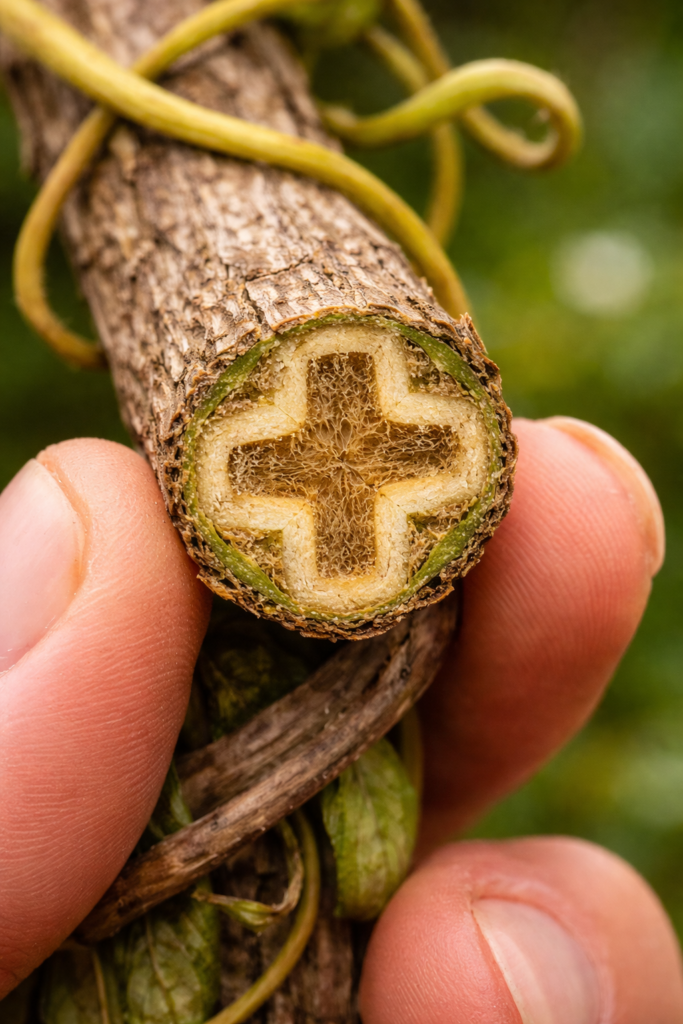
FOLK MAGIC & OLD BELIEFS
Crossvine earned a place in Appalachian lore because:
🍃 1. The stem forms a perfect “cross” when cut.
Many mountain families believed:
- It protected the home
- Brought blessings
- Repelled negativity
Some hung pieces above doorways or carried them in pockets for comfort.
🍃 2. It blooms extremely early — sometimes before spring truly arrives.
This was seen as a sign of:
- Renewal
- Hope
- Endurance
- Divine protection
🍃 3. Cherokee and Creek tribal connections
Indigenous tribes used Crossvine as:
- A pain reliever
- An anti-inflammatory
- A stimulant when energy was low
This knowledge blended into Appalachian herbal traditions as settlers learned from Native healers.
⚠️ SAFETY NOTES
Crossvine is considered mild and generally safe in traditional herbalism, but:
- Not recommended during pregnancy
- Not recommended during breastfeeding
- Avoid if allergic to members of the Bignoniaceae family
- Start with small doses to assess sensitivity
It is far gentler than many herbs but still deserves respect.
CLOSING THOUGHTS
Crossvine is one of Appalachia’s most overlooked herbal allies — a resilient climber that brings early spring color and offers generations of healing knowledge hidden in its bark and tendrils.
From pain relief to calming the nerves, from boosting circulation to soothing inflammation, Crossvine stands as one of the quiet treasures of traditional Southern herbalism.
Its long history in mountain communities reminds us that the land has always offered support, strength, and medicine to those who learned how to listen.
If you enjoy stories like this, you’ll love the other life lessons & memories I’m sharing on The Appalachian Sage. …………And if you’re ever in the mood to browse something pretty, you can stop by my Etsy shop, The Appalachian Sage Shop, where I pour the same love and kindness into each design.