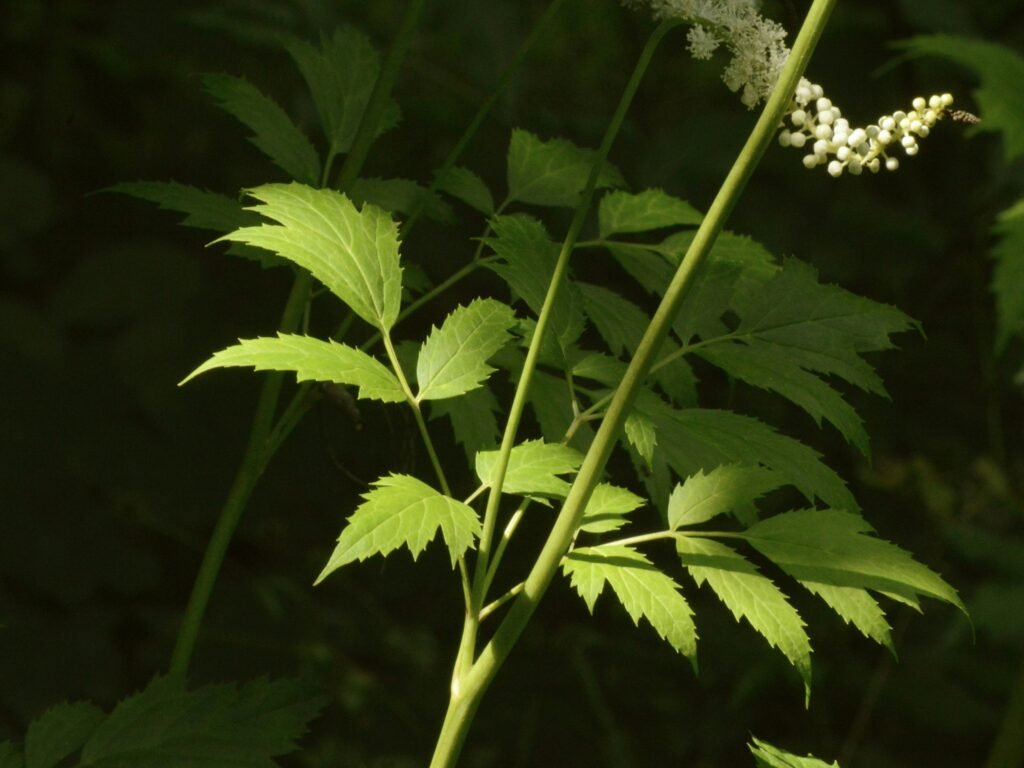
Black Cohosh (Actaea racemosa) is not a gentle meadow herb. It is a deep-woods medicine, rooted in shaded Appalachian forests and used traditionally during times of profound physical transition. For centuries, it has been respected as a plant that works not on surface symptoms, but on patterns—especially those involving cycles, tension, and change within the body.
This is a plant associated with women’s health, but its traditional use extends well beyond that single category. Black Cohosh was never a casual remedy. It was used with intention, restraint, and respect.
Botanical Overview
- Botanical name: Actaea racemosa (formerly Cimicifuga racemosa)
- Family: Ranunculaceae (buttercup family)
- Common names: Black Cohosh, Black Snakeroot, Bugbane
- Native range: Eastern North America, including Appalachia and Kentucky
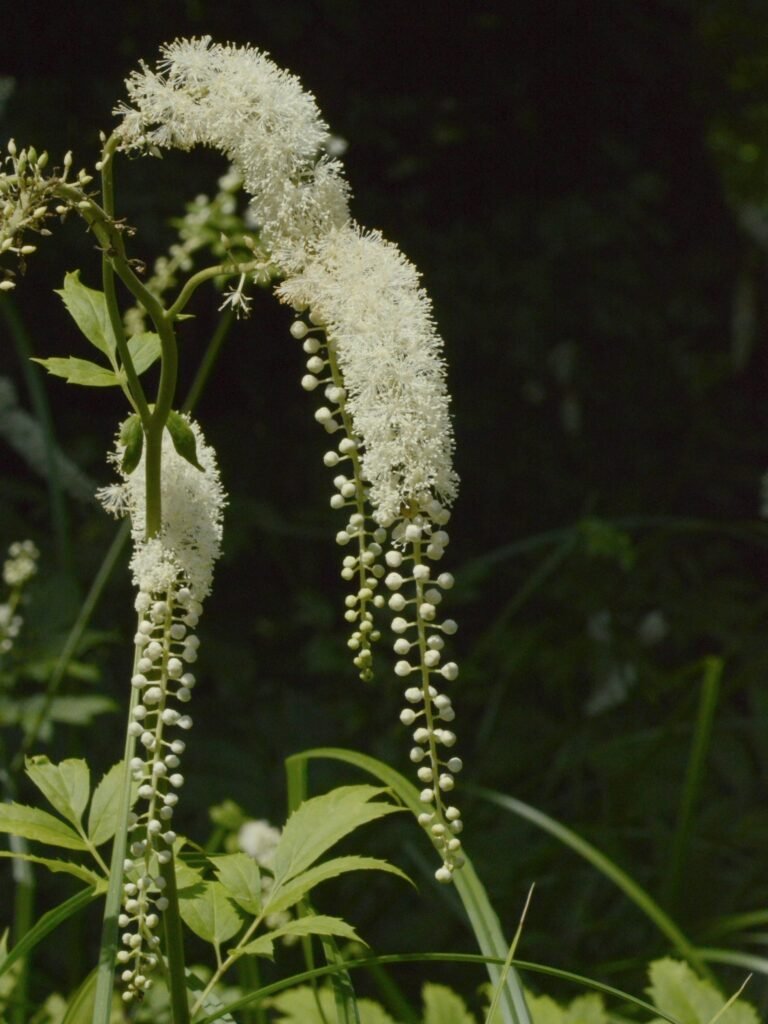
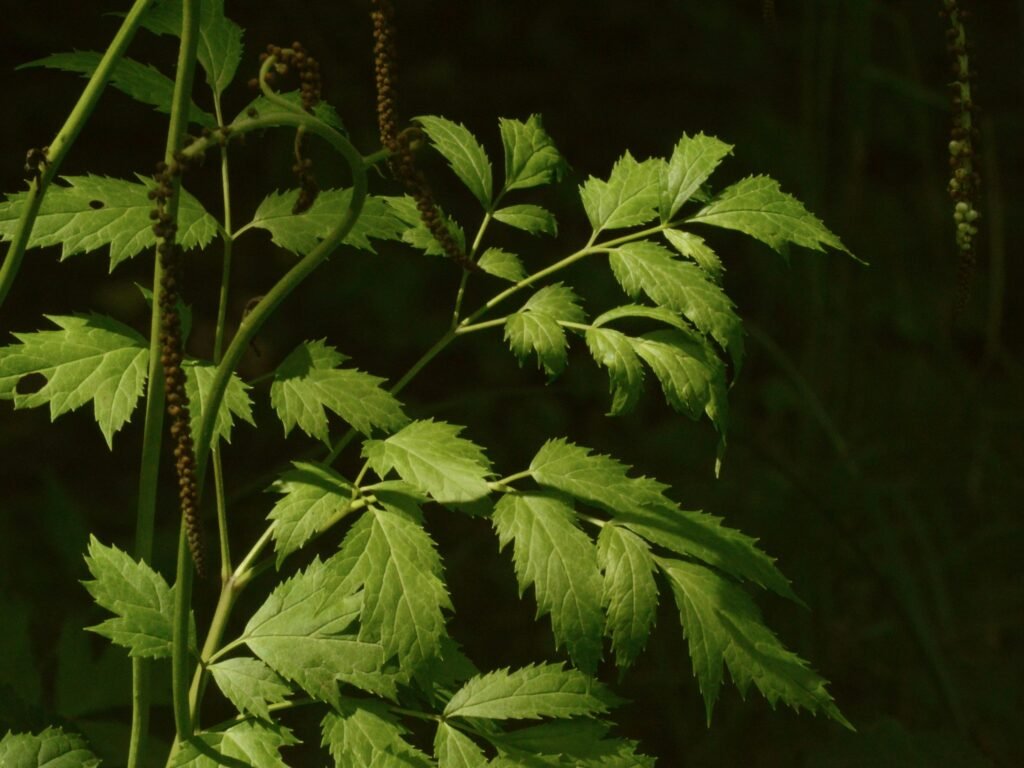
Black Cohosh is a tall perennial with long, feathery white flower spikes and a thick, dark rhizome. It grows in rich, shaded woodland soils, often near slopes and forest edges.
The root and rhizome are the medicinal parts.
Traditional Indigenous Use
Black Cohosh was used by several Native American nations, including the Iroquois, Cherokee, Delaware, and Algonquin, long before European contact.
Traditional uses included:
- Support during menstrual irregularity
- Aid during childbirth and postpartum recovery
- Relief of muscle and joint pain
- Treatment of rheumatic conditions
- Support for nervous tension and fatigue
Importantly, Black Cohosh was viewed as a regulating plant, not a stimulant. It was used to help the body return to equilibrium during periods of internal change.
Key Traditional Actions
Black Cohosh has historically been described as:
- Antispasmodic – eases muscle tension
- Anti-inflammatory
- Nervine – supports the nervous system
- Emmenagogue – influences menstrual flow
- Alterative – supports long-term systemic balance
These actions explain why it appears repeatedly in historical records related to pain, tension, and cyclical imbalance.
Chemical Components (Expanded)
Black Cohosh contains a complex group of compounds that act primarily on the nervous system, smooth muscle, and inflammatory pathways.
1. Triterpene Glycosides
These are considered the primary active compounds.
Notable examples include:
- Actein
- 27-deoxyactein
- Cimicifugoside
Actions:
- Influence neuromuscular signaling
- Support smooth muscle relaxation
- Modulate inflammatory responses
These compounds help explain Black Cohosh’s traditional use for muscle tension, cramping, and discomfort associated with hormonal transitions.
2. Phenolic Compounds
Including:
- Isoferulic acid
- Caffeic acid derivatives
Actions:
- Antioxidant activity
- Anti-inflammatory effects
- Support for connective tissue and joints
These compounds contribute to Black Cohosh’s historical use in rheumatic and inflammatory conditions.
3. Alkaloids (trace)
Present in very small amounts.
Role:
- Support nervous system signaling
- Contribute to the plant’s sedative and calming reputation
4. Tannins
Provide:
- Mild astringent action
- Tissue-toning effects
How Black Cohosh Was Traditionally Prepared
🌿 Decoction (Traditional Method)
Because the medicinal portion is a root, Black Cohosh was traditionally simmered, not steeped.
- Root simmered gently in water
- Taken in small quantities
- Used short-term, not continuously
🌿 Tincture (Modern Common Form)
Today, tincture is the most common preparation because it:
- Allows precise dosing
- Extracts triterpene glycosides efficiently
- Preserves the root long-term
🌿 External Use
Historically used in:
- Liniments
- Compresses for muscle and joint pain
Modern Context (Carefully Framed)
In modern herbal practice, Black Cohosh is widely studied for its role in:
- Menopausal transition
- Nervous system regulation
- Musculoskeletal discomfort
It is important to note that modern formulations often isolate or standardize specific compounds, while traditional use relied on whole-root preparations.
Safety & Responsible Use
Black Cohosh is powerful and not for casual use.
Important considerations:
- Not intended for long-term, continuous use
- Not recommended during pregnancy without professional guidance
- Those with liver conditions should consult healthcare providers
- Use only under informed supervision
This is a plant of cycles and transitions, not daily supplementation.
Ecological & Ethical Considerations
Black Cohosh has been overharvested in some regions.
Ethical use includes:
- Purchasing from reputable, sustainably sourced suppliers
- Avoiding wild harvesting unless deeply knowledgeable and permitted
- Supporting cultivation over wild collection
Respect for the plant includes respect for its future.
Final Reflection
Black Cohosh is a plant that steps in when the body is shifting—when old rhythms no longer hold and new ones have not yet settled. It does not force change; it supports the body through it.
Like many deep-forest medicines, it teaches patience, balance, and restraint.
This is not a plant for every day.
It is a plant for threshold moments.
Educational Disclaimer
This article is provided for educational and historical purposes only and is not intended to diagnose, treat, cure, or prevent any disease. Always consult a qualified healthcare professional before using herbs, especially during pregnancy, while taking medications, or when managing a medical condition.
If you enjoy stories like this, you’ll love the other life lessons & memories I’m sharing on The Appalachian Sage. …………And if you’re ever in the mood to browse something pretty, you can stop by my Etsy shop, The Appalachian Sage Shop, where I pour the same love and kindness into each design.