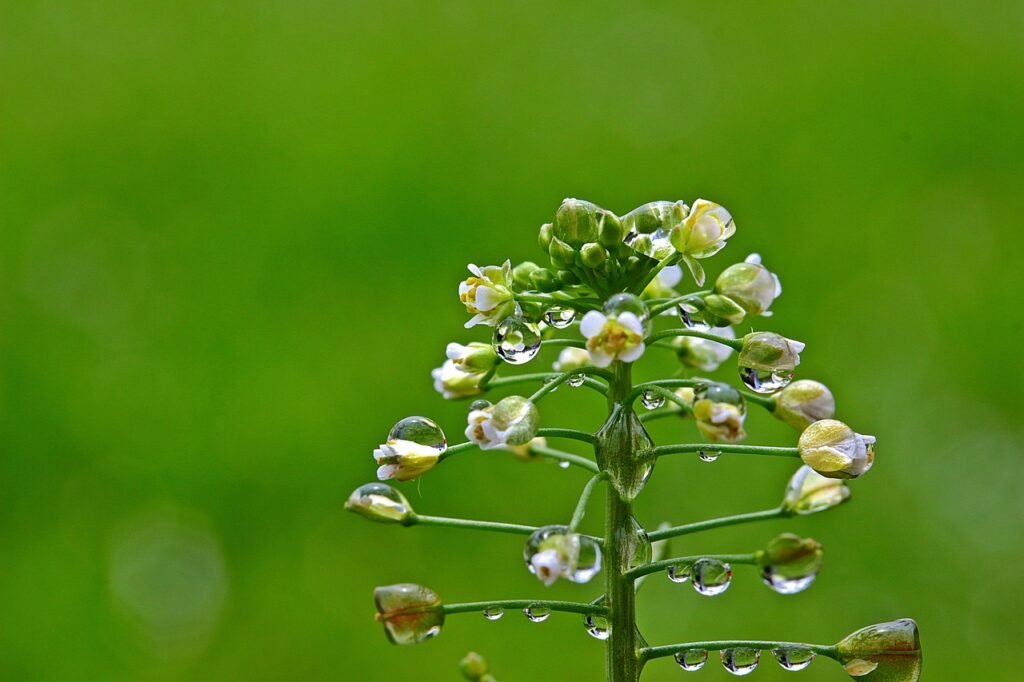

Shepherd’s Purse (Capsella bursa-pastoris) is one of those plants people walk past every day without a second glance—yet for centuries it has been trusted in moments when the body needed help now. Found growing in yards, fields, roadsides, and disturbed soil, Shepherd’s Purse is a quiet ally with a very specific gift: it knows how to bring things back into balance, especially blood flow, when the body is losing more than it should.
Named for its small, heart-shaped seed pods that resemble an old shepherd’s pouch, this unassuming wild plant has been used across Europe, Asia, and North America as both food and medicine. It is especially known for its relationship with the blood.
A Brief History & Origin
Shepherd’s Purse is native to Europe and Asia, but today it grows worldwide. It followed agriculture, settlement, and footpaths—thriving wherever humans disturbed the soil. Long before it was used medicinally for folk healers, it was common food for many cultures.
Traditional Food Uses of Shepherd’s Purse Around the World
Shepherd’s Purse has been eaten for centuries as a spring green, valued for nourishment after winter scarcity. When used as food, it is harvested young and tender.
🇨🇳 China (Very Well-Documented)
In China, Shepherd’s Purse is called 荠菜 (Jìcài) and is widely consumed.
Common Uses:
- Dumpling filling (mixed with pork, tofu, or eggs)
- Savory pancakes
- Soups and broths
- Rice porridge additions
Traditional belief:
Jìcài is considered:
- Cooling
- Cleansing
- Supportive to the blood
- Beneficial in early spring
It is both food and medicine, without a hard line between the two.
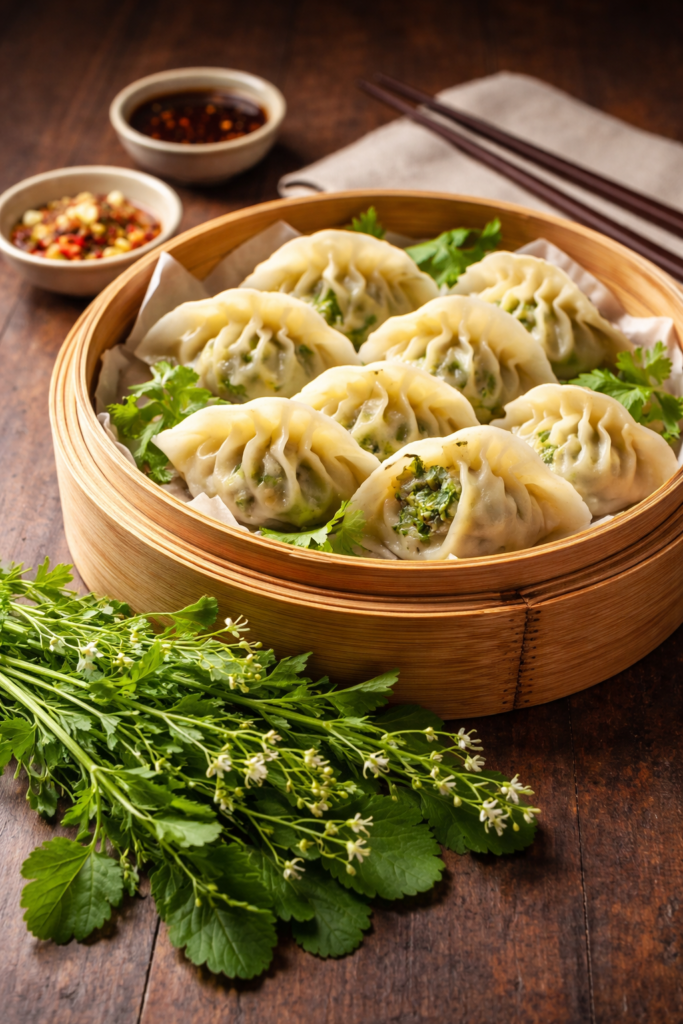
Traditional Chinese Shepherd’s Purse Dumpling Filling (荠菜饺子馅)
This filling is commonly eaten in early spring, when Shepherd’s Purse is young and tender. It’s valued for being nourishing, grounding, and gentle on digestion.
Ingredients
- 2 packed cups fresh Shepherd’s Purse leaves (young plants only)
- ½ lb ground pork
(or substitute firm tofu for a vegetarian version) - 2–3 green onions, finely chopped
- 1 tablespoon fresh ginger, minced
- 1 tablespoon soy sauce
- 1 tablespoon sesame oil
- 1 tablespoon Shaoxing wine
(or dry sherry) - ½ teaspoon salt
- ¼ teaspoon white pepper
- Optional: 1 teaspoon sugar (traditional in some regions)
Preparing the Shepherd’s Purse
- Wash thoroughly to remove grit.
- Blanch briefly in boiling water (about 30–60 seconds).
- Immediately transfer to cold water.
- Squeeze out excess moisture.
- Finely chop.
This step removes bitterness and softens the greens.
Making the Filling
- In a bowl, mix ground pork with soy sauce, sesame oil, Shaoxing wine, ginger, salt, white pepper, and sugar.
- Stir in one direction until slightly sticky (this improves texture).
- Fold in chopped Shepherd’s Purse and green onions.
- Let rest 10–15 minutes before filling dumplings.
To Use
- Spoon filling into dumpling wrappers
- Seal and cook by:
- Boiling
- Steaming
- Or pan-frying (potstickers)
Serve with black vinegar, soy sauce, or chili oil.
Cultural Notes (Good for Your Article)
- In China, this dish is associated with spring cleansing and renewal
- Shepherd’s Purse is believed to “clear” the body gently after winter
- This filling balances greens + protein + warming aromatics
- It is considered both food and traditional wellness cuisine
Important Herbal Distinction
As food:
- Uses young leaves
- Gentle and nourishing
- Seasonal
As medicine:
- Uses mature aerial parts
- Short-term, acute use
- Different intention entirely
This distinction was always understood traditionally.
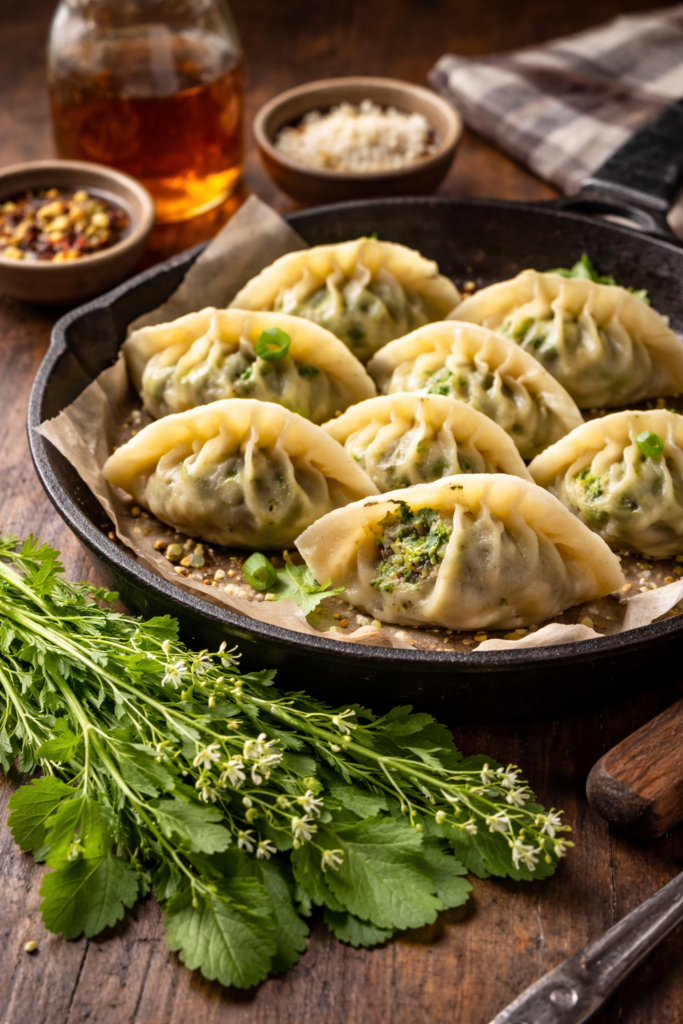
Appalachian Shepherd’s Purse Dumplings
A Mountain Interpretation of a Global Spring Food
In Appalachia, spring greens were never wasted. Like the Chinese use of jìcài, mountain families relied on tender wild plants after winter to wake the body and stretch scarce stores. This Appalachian version keeps Shepherd’s Purse at the center, seasoned with familiar mountain flavors.
Ingredients (Filling)
- 2 packed cups fresh Shepherd’s Purse, young and tender
- ½ lb ground pork or ground venison
(bacon-end trimmings were also traditional) - 2 green onions or ramps, finely chopped
- 1 small yellow onion, minced
- 1 clove garlic, finely minced
- ½ teaspoon salt
- ¼ teaspoon black pepper
- ¼ teaspoon dried sage or thyme
- 1 tablespoon lard or bacon grease
- Optional: pinch of crushed red pepper
Preparing the Shepherd’s Purse
- Wash thoroughly to remove grit.
- Blanch briefly in boiling water (30–60 seconds).
- Cool immediately in cold water.
- Squeeze dry and chop fine.
This mirrors both Chinese and Appalachian methods for taming wild greens.
Mixing the Filling
- In a bowl, combine meat, onion, garlic, herbs, salt, and pepper.
- Add Shepherd’s Purse and mix well.
- Stir in melted lard or bacon grease for moisture and richness.
- Let rest 10–15 minutes.
Dumpling Wrappers (Two Appalachian Options)
Option 1: Store-bought dumpling wrappers
Simple, practical, and perfectly acceptable — just like mountain cooks adapting what they had.
Option 2: Appalachian Dough
- 2 cups flour
- ¾ cup warm water
- Pinch of salt
Mix, knead lightly, rest 30 minutes, then roll thin and cut into rounds.
Cooking Methods (Mountain Style)
- Boiled in salted water until dumplings float
- Pan-fried in a cast-iron skillet with a little lard
- Steamed over simmering water
Serve hot.
Appalachian Serving Ideas
Instead of soy sauce, try:
- Apple cider vinegar with black pepper
- Vinegar and sorghum drizzle
- Melted butter with cracked pepper
- Hot pepper vinegar
These mirror the sharp, cleansing flavors traditionally paired with spring greens.
Cultural Connection
Though oceans apart, Chinese and Appalachian food traditions share a truth:
Spring greens are medicine first — food second.
Shepherd’s Purse dumplings in Appalachia would have been:
- A way to stretch meat
- A way to cleanse after winter
- A way to honor what the land freely gave
Different seasonings, same wisdom.
Herbal Note
As food:
- Uses young leaves
- Nourishing, grounding
- Seasonal
As medicine:
- Mature plant
- Short-term use
- Purpose-driven
Mountain people understood this distinction instinctively.
🇰🇷 Korea
In Korea, Shepherd’s Purse is part of seasonal mountain greens known as “namul.”
Common Preparations:
- Lightly blanched and seasoned with sesame oil, garlic, and salt
- Added to soups and rice dishes
- Consumed in early spring for renewal
Cultural context:
Spring greens are believed to:
- Wake digestion
- Restore vitality
- Cleanse the body gently
🇯🇵 Japan
In Japan, Shepherd’s Purse is known as Nazuna.
Famous Dish:
Nanakusa-gayu (Seven-Herb Rice Porridge)
- Eaten in January
- Shepherd’s Purse is one of the seven herbs
- Symbolizes purification and health for the coming year
This dish is deeply traditional and ceremonial, not trendy.
🇪🇺 Europe (Historical Use)
In medieval and early modern Europe, Shepherd’s Purse was a poverty and famine food.
Uses included:
- Spring soups
- Pot herbs
- Mixed greens
- Bread and porridge additions
It was eaten especially when gardens were not yet producing.
🇺🇸 Early American & Appalachian Use
In early American settlements, Shepherd’s Purse:
- Was eaten as a spring green
- Added to mixed greens or soups
- Sometimes cooked with fatback or bacon grease
Food and medicine overlapped heavily in these traditions.
What Parts Are Used as Food?
- Young leaves (best before flowering)
- Tender stems
- Occasionally immature seed pods
Older plants become fibrous and bitter and were typically reserved for medicinal use.
Taste Profile
- Mild
- Slightly peppery
- Similar to cress or mustard greens
- Very gentle compared to stronger wild greens
Important Safety Distinction (Food vs Medicine)
When used as food:
- Harvest young
- Use small amounts
- Treat as a seasonal green
- Avoid daily large servings
When used medicinally:
- Dried or tinctured
- Short-term only
- Purpose-driven
This distinction is essential and historically understood.
Long before modern medicine used it:
- European folk healers
- Midwives
- Battlefield medics
- Indigenous healers after its arrival in North America
Its reputation crossed borders quickly because its effects were observable and reliable.
Key Medicinal Actions
Shepherd’s Purse is best known as a styptic and hemostatic plant—meaning it helps slow or stop bleeding.
Traditional and modern herbal actions include:
- Hemostatic (reduces bleeding)
- Astringent (tightens tissues)
- Anti-inflammatory
- Mild diuretic
- Uterine tonic
- Circulatory regulator
This is a plant of control and containment, not stimulation.
Active Components (Expanded)
Shepherd’s Purse contains a combination of compounds that explain its long-standing use:
🌿 Flavonoids
Flavonoids (Quercetin, Kaempferol derivatives)
Flavonoids are one of the most important compound groups in Shepherd’s Purse. These plant pigments are well studied for their role in vascular integrity and inflammation control.
In Shepherd’s Purse, flavonoids:
- Strengthen capillary walls
- Reduce capillary fragility (which contributes to micro-bleeding)
- Modulate inflammatory signaling pathways
- Act as antioxidants, protecting blood vessels from oxidative stress
This helps explain why Shepherd’s Purse is effective not only for visible bleeding, but also for internal or diffuse bleeding, such as heavy menstruation or capillary seepage.
Flavonoids also influence smooth muscle tone, contributing to the plant’s ability to regulate uterine and vascular contraction without acting as a harsh stimulant.
🌿 Tyramine
Tyramine is a naturally occurring monoamine compound that directly affects smooth muscle contraction.
In the body, tyramine:
- Influences vascular tone
- Acts on smooth muscle tissue, including the uterus
- Contributes to vasoconstrictive responses
This compound helps explain Shepherd’s Purse’s historical use in:
- Uterine bleeding
- Postpartum hemorrhage
- Menstrual flooding
Unlike stimulant herbs, tyramine does not force action—it supports the body’s own regulatory response, tightening tissues when they are overly relaxed.
Because tyramine affects blood pressure regulation, this is one reason Shepherd’s Purse should be used short-term and intentionally, not daily.
🌿 Choline
Choline is a nutrient-like compound essential for:
- Cell membrane integrity
- Nerve signal transmission
- Muscle contraction
In Shepherd’s Purse, choline contributes to its ability to influence neuromuscular coordination, especially in smooth muscle tissues such as:
- Uterus
- Blood vessels
- Digestive tract
This helps explain why the plant was traditionally valued by midwives. It does not simply “stop bleeding”; it supports proper muscular response, allowing tissues to contract when necessary and relax afterward.
Choline’s presence also links Shepherd’s Purse to broader systemic regulation rather than isolated symptom control.
🌿 Tannins
Tannins are responsible for Shepherd’s Purse’s astringent properties.
Astringents:
- Tighten tissues
- Reduce secretions
- Constrict small blood vessels
- Create a protective layer over mucous membranes
In Shepherd’s Purse, tannins:
- Help slow bleeding at wound sites
- Reduce excessive uterine discharge
- Support hemorrhoidal tissue tone
- Assist in minor gastrointestinal bleeding
This astringency works locally and systemically, making the plant useful both internally and externally.
While Shepherd’s Purse is not a mineral powerhouse, it contains small amounts of:
- Potassium
- Calcium
- Iron (trace)
These minerals support:
- Vascular tone
- Muscle contraction
- Blood recovery following loss
Their presence reinforces the plant’s role as a restorative agent, not just an emergency stopgap.
🌿 Organic Acids
Organic acids play subtle but important roles in Shepherd’s Purse’s action.
Organic Acids Identified in Shepherd’s Purse
Shepherd’s Purse contains several low-molecular-weight organic acids that contribute to its circulatory, metabolic, and astringent actions. These acids are supportive compounds, not the primary hemostatic agents, but they matter for how the plant works.
1. Fumaric Acid
This is the most frequently cited organic acid in Shepherd’s Purse.
What it does in the body:
- Participates in the Krebs (citric acid) cycle → cellular energy metabolism
- Supports circulation and tissue oxygenation
- Has documented anti-inflammatory and immunomodulatory properties
Why it matters in Shepherd’s Purse:
Fumaric acid supports recovery after blood loss by assisting cellular energy processes and reducing inflammatory stress. This helps explain why the plant was used not only to stop bleeding, but also to support post-bleeding recovery.
2. Malic Acid
Malic acid is common in many green plants and is present in Shepherd’s Purse.
What it does:
- Supports energy production at the cellular level
- Assists muscle function, including smooth muscle
- Helps regulate acid–base balance
Role in Shepherd’s Purse:
Malic acid supports smooth muscle efficiency, complementing the actions of tyramine and choline. This contributes to coordinated uterine and vascular contraction rather than spasmodic action.
3. Citric Acid
Present in smaller amounts.
Functions:
- Chelates minerals (improves bioavailability)
- Supports metabolic waste processing
- Mild preservative and antimicrobial effect
Contribution to herbal action:
Citric acid supports circulation and detox pathways, helping tissues clear metabolic byproducts after inflammatory or bleeding events.
4. Oxalic Acid (trace)
Found in low, non-problematic amounts.
Important clarification:
- Present at levels far lower than plants like sorrel or spinach
- Not a safety concern in normal medicinal use
Role:
Oxalic acid contributes to the plant’s mineral-binding and tissue-toning effects but is not a primary actor.
How These Organic Acids Work Together
In Shepherd’s Purse, organic acids:
- Support metabolic recovery
- Assist smooth muscle coordination
- Improve circulatory efficiency
- Aid in post-bleeding tissue repair
They do not stop bleeding directly — that role belongs mainly to:
- Flavonoids
- Tannins
- Tyramine-related smooth muscle effects
Instead, organic acids help the body restore equilibrium after an acute event.
Essential Trace Minerals
- Support circulation
- Assist metabolic waste processing
- Contribute to the plant’s mild diuretic effect
- Support connective tissue health
These acids help the body restore balance after bleeding events, aiding recovery rather than merely stopping the symptom.
Traditional Uses
Historically, Shepherd’s Purse was used for:
- Excessive menstrual bleeding
- Postpartum bleeding (under experienced guidance)
- Nosebleeds (internal tea or external compress)
- Bleeding wounds
- Hemorrhoids
- Blood in urine
- Minor internal bleeding
Midwives valued it not as a stimulant, but as a regulator—used when things were flowing too freely.
How to Preserve Shepherd’s Purse for Apothecary Use
Shepherd’s Purse should be preserved with the understanding that it is an “as-needed” remedy, not a shelf tea for casual drinking. The goal is readiness, not volume.
1. Tincture (Best All-Around Apothecary Form)
This is the most reliable preservation method.
Why tincture works best:
- Preserves the plant’s fast hemostatic action
- Extracts flavonoids, tyramine, tannins, and organic acids
- Keeps for many years when stored properly
- Allows small, intentional use
Traditional method:
- Harvest fresh aerial parts (leaves, stems, flowers, seed pods)
- Chop finely
- Cover completely with alcohol (vodka or brandy traditionally used)
- Seal and store in a dark place
- Shake gently every few days
- Strain after 4–6 weeks
Apothecary note:
Fresh-plant tinctures are preferred for Shepherd’s Purse because some of its active compounds diminish with drying.
2. Dried Herb (Secondary, Short-Term Use)
Drying Shepherd’s Purse is acceptable, but it is not the strongest form.
Best use for dried herb:
- Short-term tea
- Emergency use when tincture isn’t available
- External compresses
How to dry properly:
- Harvest before the plant becomes tough and fibrous
- Hang in small bundles or lay flat on screens
- Dry quickly, out of direct sunlight
- Store in airtight glass jars, away from heat and light
Shelf life:
~1 year before potency noticeably declines
3. Vinegar Extract (Gentler Option)
Herbal vinegar is useful for:
- Those avoiding alcohol
- Short-term storage
- Mild circulatory support
Method:
- Chop fresh plant
- Cover with raw apple cider vinegar
- Cap with non-metal lid
- Steep 4–6 weeks
- Strain and store in glass
Note:
Vinegar extracts are gentler and less potent than tinctures for acute bleeding situations.
4. Glycerite (Alcohol-Free, Less Potent)
A glycerite can be made but is not ideal for Shepherd’s Purse.
Why:
- Glycerin does not extract tannins and tyramine as efficiently
- Best reserved for children or those who cannot tolerate alcohol
5. Fresh Plant Poultice (Immediate, Not Stored)
Historically, Shepherd’s Purse was often used fresh, crushed and applied directly.
This method:
- Is for immediate use only
- Is not preserved
- Was common on farms and battlefields
What NOT to Do
- ❌ Do not powder it for capsules (loses acute action)
- ❌ Do not store in plastic
- ❌ Do not blend into daily herb mixes
- ❌ Do not preserve as an essential oil (not appropriate)
Ideal Apothecary Setup for Shepherd’s Purse
If you were stocking a traditional apothecary, the best setup would be:
- ✅ One dark-glass bottle of fresh-plant tincture
- ✅ A small jar of dried aerial parts as backup
- ✅ Clear labeling: “Acute use only”
That’s it. Shepherd’s Purse doesn’t want to be complicated.
Traditional Wisdom to Include in Your Writing
Shepherd’s Purse was not kept for comfort — it was kept for moments.
It sat on shelves waiting quietly, untouched most of the time, until the day it was needed. When that day came, it worked quickly — and then it was put away again.
That is the mark of a true acute remedy.
Food Use
Shepherd’s Purse has long been eaten as a spring green.
- Young leaves can be added to soups, broths, and stir-fries
- Popular in parts of China and Korea, where it appears in dumplings and savory dishes
- Taste is mild, slightly peppery
As food, it offers nourishment; as medicine, it offers restraint.
Modern Medical Context (Without Naming Names)
Today, compounds found in Shepherd’s Purse are studied and utilized in modern formulations designed to:
- Reduce bleeding
- Support vascular tone
- Assist postpartum recovery
- Address circulatory imbalance
The plant itself remains a foundational reference point in herbal and integrative medicine.
Safety & Cautions
Shepherd’s Purse is powerful because it acts quickly.
Important notes:
- Not for long-term daily use
- Avoid during pregnancy unless guided by an experienced practitioner
- Those with blood pressure sensitivity should use with care
- Best used when needed, not casually
This is a plant that responds when called—but should not be overused.
Why Shepherd’s Purse Is Considered an Acute-Use Herb Only
Shepherd’s Purse (Capsella bursa-pastoris) is classified as an acute-use medicinal herb, meaning it is intended for short-term, situation-specific use, not for daily or ongoing supplementation.
This classification is based on how the plant acts on the body, not on fear or toxicity.
1. Shepherd’s Purse Actively Alters Vascular Tone
Unlike nutritive herbs (such as nettle or red clover), Shepherd’s Purse directly influences blood vessel behavior.
Its compounds:
- Encourage vasoconstriction (tightening of blood vessels)
- Reduce capillary leakage
- Increase tissue tone through astringent action
These effects are beneficial during active bleeding, but counterproductive if sustained long-term.
Prolonged use may:
- Over-tighten tissues
- Reduce healthy circulation
- Interfere with normal vascular flexibility
The body needs vessels to open and close dynamically, not remain in a semi-contracted state.
2. It Modulates Smooth Muscle — Especially the Uterus
Shepherd’s Purse affects smooth muscle tissue, particularly:
- Uterine muscle
- Vascular smooth muscle
This is why it has a long history of use in:
- Excessive menstrual bleeding
- Postpartum bleeding
- Uterine hemorrhage
However, continuous modulation of smooth muscle can disrupt natural hormonal and muscular rhythms if used daily.
In simple terms:
Shepherd’s Purse tells muscles when to tighten.
It is not meant to keep telling them that message every day.
3. Presence of Tyramine Requires Intentional Use
Shepherd’s Purse contains tyramine, a bioactive monoamine.
Tyramine:
- Influences blood pressure regulation
- Affects vascular responsiveness
- Acts quickly in the body
This makes Shepherd’s Purse effective in acute situations, but unsuitable for chronic use — especially for individuals sensitive to blood pressure changes.
This is another reason it is used:
- In small doses
- For short durations
- With clear purpose
4. It Is Not a Nutritive or Rebuilding Herb
Some herbs are designed to be taken daily because they:
- Feed the body
- Restore mineral balance
- Support long-term vitality
Shepherd’s Purse does none of these things.
It does not:
- Build blood
- Provide meaningful vitamins or minerals
- Support daily organ nourishment
Its role is intervention, not maintenance.
Once balance is restored, its job is done.
5. Traditional Use Confirms This Pattern
Historically, Shepherd’s Purse was:
- Used when bleeding was present
- Stopped once bleeding resolved
- Not brewed as a daily tea
- Not used as a seasonal tonic
Midwives, battlefield healers, and folk practitioners treated it as a tool, not a food.
The wisdom was simple:
Use it when you need it.
Stop when you don’t.
What “Acute Use” Means in Practice
Acute use typically means:
- Hours to a few days
- Occasionally up to a short menstrual window
- Not weeks or months
- Not daily or preventive use
Once the symptom resolves, the herb is discontinued.
The Core Principle
Shepherd’s Purse is a plant of correction, not nourishment.
It steps in when something is flowing too freely, helps restore control, and then steps back.
Using it beyond that point doesn’t add benefit — it interferes with the body’s natural regulation.
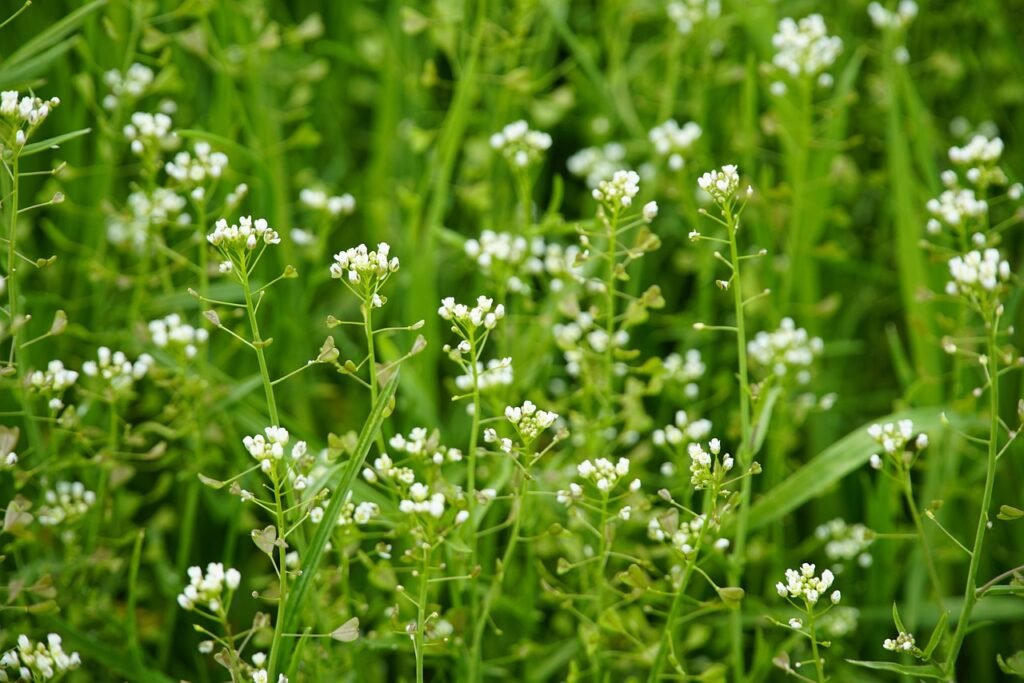
Where It Grows
Shepherd’s Purse grows:
- Throughout the United States
- Across Europe and Asia
- In temperate regions worldwide
Look for it in early spring, thriving in disturbed soils where few others settle.
Final Thoughts
Shepherd’s Purse reminds us that strength does not always shout. Some plants work quietly, efficiently, and without ceremony—stepping in only when balance is lost.
It is a plant of containment, correction, and care. One that teaches us the value of restraint, and the wisdom of knowing when enough is enough.
Sometimes healing doesn’t mean adding more.
Sometimes healing means helping the body hold on.
If you enjoy stories like this, you’ll love the other life lessons & memories I’m sharing on The Appalachian Sage. …………And if you’re ever in the mood to browse something pretty, you can stop by my Etsy shop, The Appalachian Sage Shop, where I pour the same love and kindness into each design.